
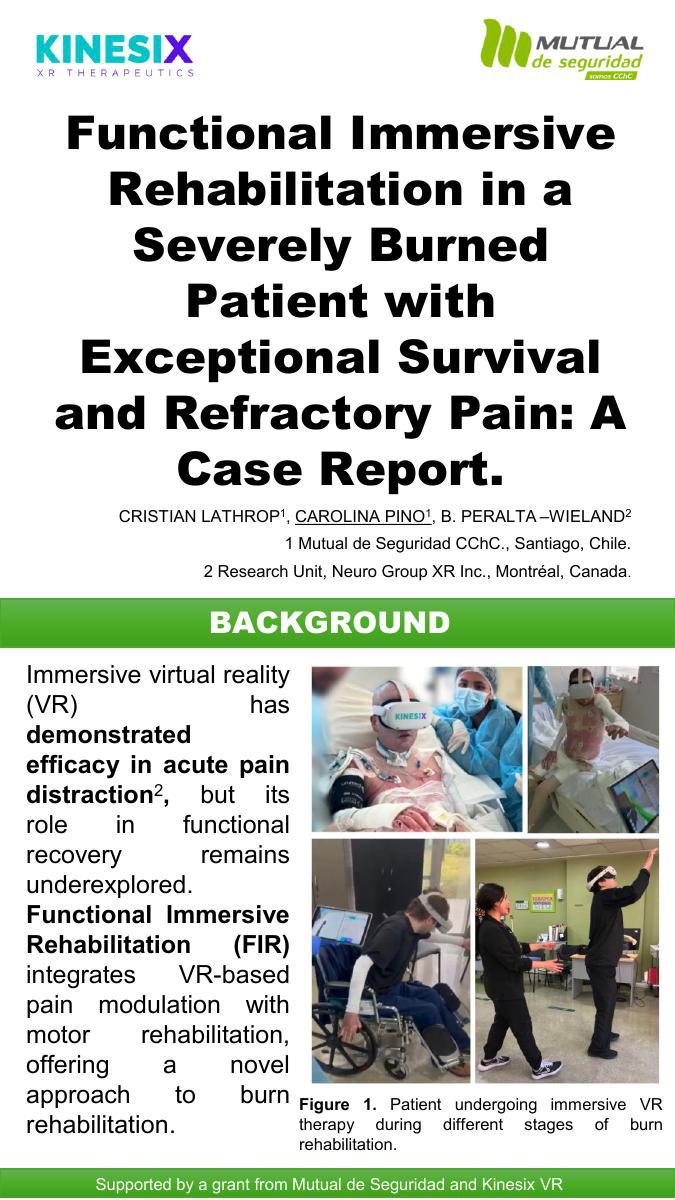
Introduction / Rationale:
Severe burn injuries pose significant rehabilitation challenges, particularly in pain management. Conventional pharmacological approaches often fail to provide adequate relief and carry opioid dependency risks. Immersive Virtual Reality (IVR) has emerged as a non-pharmacological alternative, leveraging distraction and multisensory engagement. Functional Immersive Rehabilitation (FIR) integrates IVR with motor training in enriched environments. This case report examines FIR's feasibility and impact in a firefighter with extensive burns and refractory pain.
Objectives:
To describe FIR implementation in a severely burned patient and its effects on pain and function.
Methods / Approach:
A 24-year-old male with 60% total body surface area burns required prolonged intensive care. Due to severe pain (9/10) and limited tolerance to conventional therapy, a 12-session FIR protocol (3x/week, 60 min) using the Kinesix VR system was implemented. Pain-related (sensory, affective, cognitive) and VR-related (immersion, realism, satisfaction, nausea) outcomes were assessed via Graphic Rating Scales. Functional recovery was tracked via Functional Independence Measure (FIM).
Results / Practice Implications:
Procedural pain significantly decreased (p = 0.003, Wilcoxon), from severe (median: 8, IQR: 8-8) to moderate (4, IQR: 2.25-5) during sessions. The patient reported high immersion (6.5, IQR: 6-8.5) and satisfaction (6, IQR: 5-7), with no nausea. Pain intensity inversely correlated with immersion (p = 0.016, Sperman), suggesting extreme pain levels reduced VR engagement. Functionally, he progressed from complete dependence (FIM motor: 13/91) to assisted walking (FIM motor: 45/91), achieving greater independence (FIM motor: 59/91) at follow-up.
Conclusion:
FIR was feasible, well-tolerated, and associated with reduced procedural pain and improved function. Its integration into ocupation therapy could enhance pain management and motor recovery in burn survivors.