
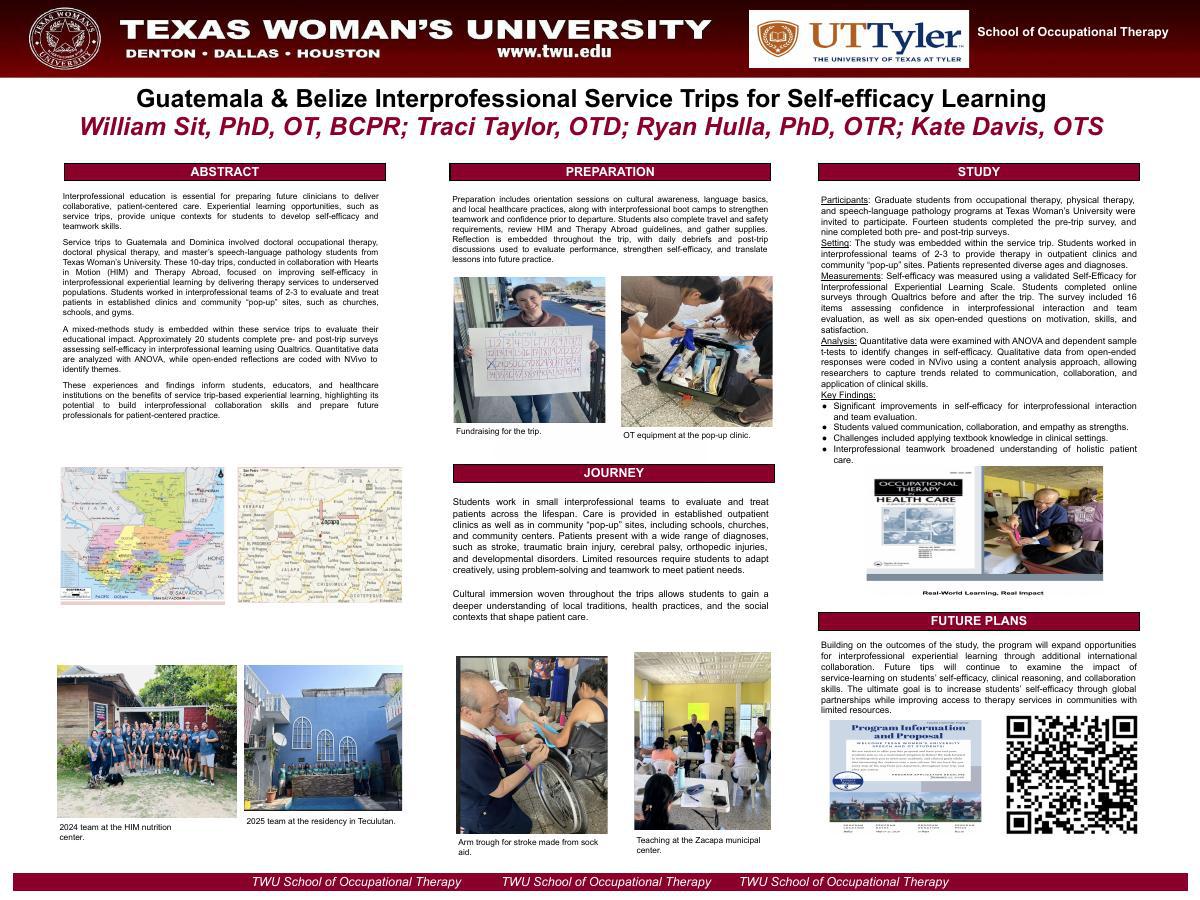
Introduction: The Texas Woman's University education abroad trip to Guatemala and Dominica, in partnership with Hearts in Motion (HIM) and Therapy Abroad (TA), involved doctoral entry-level occupational therapy, doctoral physical therapy, and master’s speech therapy students. These service-learning experiences addressed the healthcare needs in underserved communities in Guatemala and Dominica and fostered interprofessional experiential learning. The rationale for the trips are to enhance students’ self-efficacy through real-world therapy practice.
Objectives: After reading the poster, the learner will:
Recall at least three steps in the preparation and/or development of international service-learning opportunities.
Identify at least two rationales for building self-efficacy in interprofessional education and clinical practice.
Name at least two strategies for improving self-efficacy skills during collaboration practice.
Methods: This mixed-methods study involved fourteen students across occupational, physical, and speech therapy programs. Participants completed pre- and post-trip surveys using Qualtrics to assess changes in self-efficacy related to interprofessional learning. Data was analyzed quantitatively with a repeated measures analysis of variance test and qualitatively with software in data analysis.
Results/Practice Implications: The study examined how international service trips impact occupational therapy students’ confidence in interprofessional skills. Results offered insights into how experiential learning can improve self-efficacy and inform future practice.
Conclusion/Significance to the Occupational Therapy Profession: The service trips highlight the value of interprofessional education and international service learning in enhancing healthcare professionals’ confidence and abilities. The research offers practical implications for occupational therapy educators and practitioners seeking to incorporate experiential learning into training programs.