
Introduction/Rationale: A Chicago faith-based, community-supported initiative sought innovative ways to assist asylum-seeking migrant families amid escalating anti-immigrant policies and rhetoric. As threats of deportation, punitive immigration measures, and public hostility made long-term resettlement increasingly difficult, the initiative expanded its focus beyond housing and employment to include protection and advocacy.
Objectives: This presentation applies an occupational therapy lens and principles of occupational justice to explore how diverse partnerships—including faith-based organizations, grassroots movements, social service agencies, government officials, and migrant families—fostered creative, community-driven solutions for migrant well-being and inclusion.
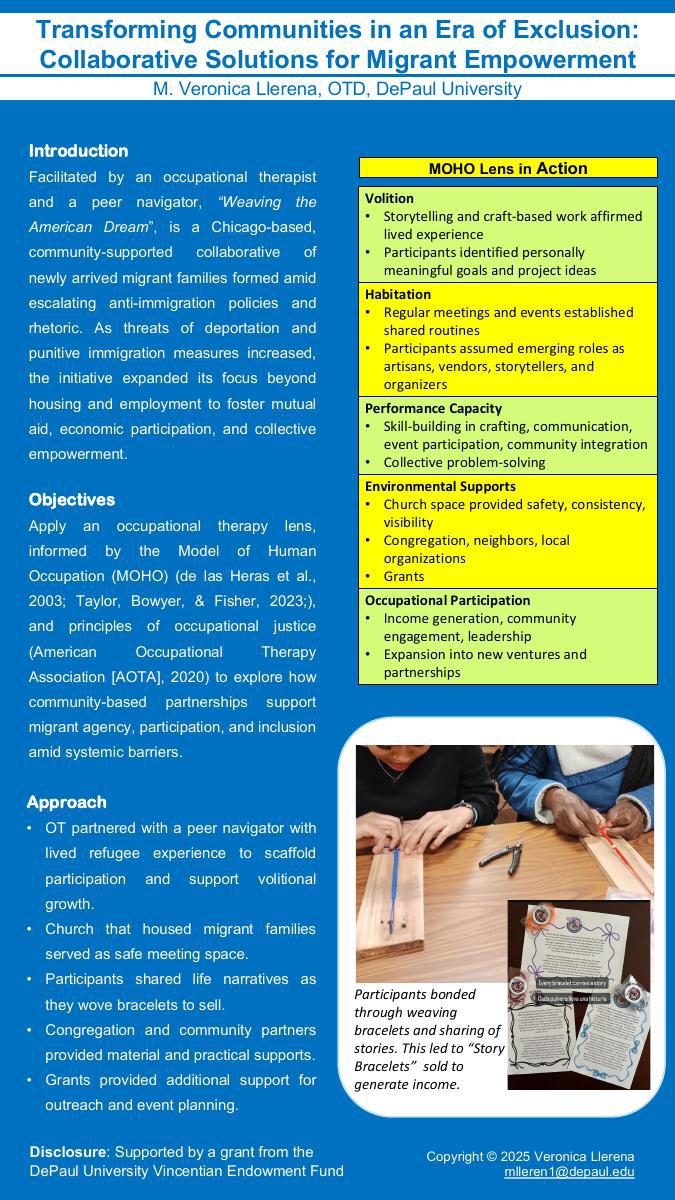
Methods/Approach: Using occupation as both a means and an outcome, an occupational therapist volunteering with the initiative since its inception partnered with a peer navigator—a refugee with lived experience—to create spaces where migrant families could reclaim agency and build sustainable livelihoods, such as a bracelet-making project that generates income while fostering mutual support, storytelling, and identity reconstruction. The project has empowered migrant women to develop additional ventures, such as selling traditional foods and catering events.
Results/Practical Implications: As shifting U.S. immigration policies create new uncertainty, the project strengthens the potential for sustainable income generation and the sharing of migrant stories through social media, technology, and local networks. By deepening community partnerships, the project amplifies migrant voices and challenges dehumanizing rhetoric.
Conclusion/Significance to Occupational Therapy: This work underscores the role of lived experience in driving solutions. This model of mutual aid and occupational justice serves as a blueprint for fostering belonging, empowerment, and community transformation in the face of systemic barriers.