
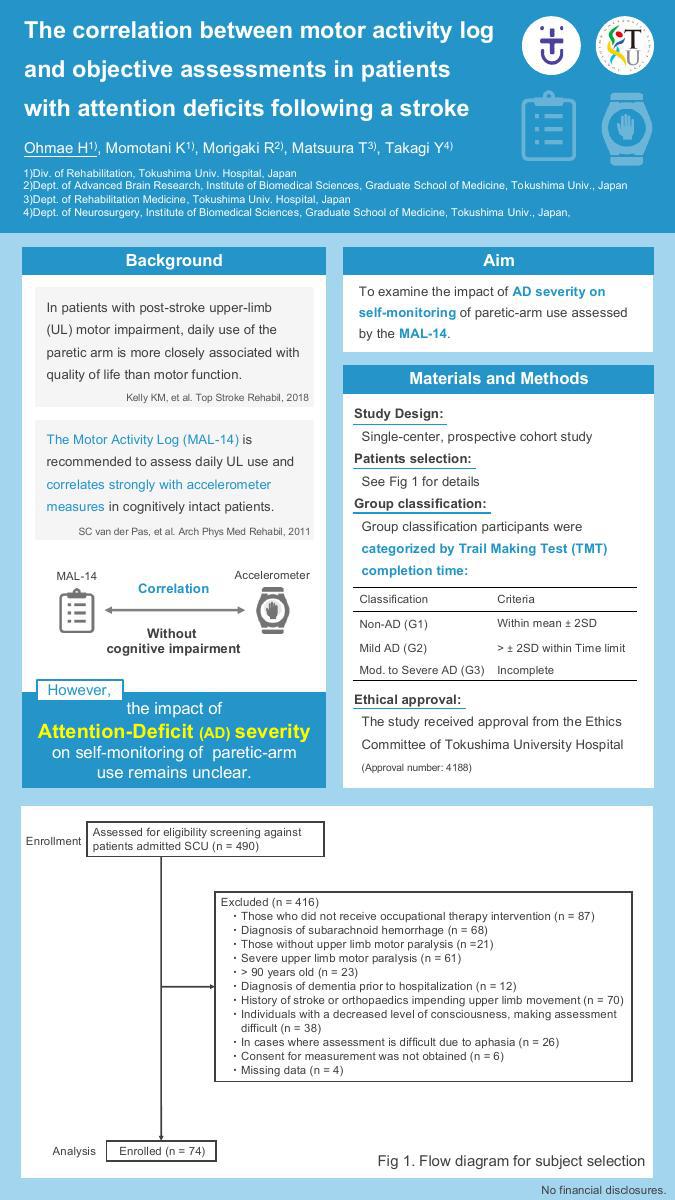
Introduction: The reduced frequency of paralyzed upper limb use following a stroke significantly affects quality of life. While various factors influence upper limb use, the relationship with attention deficits remains unclear.
Objectives: This study aimed to evaluate the impact of attention deficit severity on motor activity log (MAL) scores in patients with stroke.
Methods: Patients admitted to our stroke care unit between 2022 and 2024 who met the inclusion criteria were categorized into three groups: Group 1 (no attention deficit), Group 2 (mild attention deficit), and Group 3 (severe attention deficit). Attention deficits were assessed using the Trail Making Test Japanese Edition. In each group, MAL scores and objective assessments, including magnitude ratio (MR) and use ratio (UR) obtained via an ActiGraph GT9X (ActiGraph Corp, USA), were evaluated. Spearman’s rank correlation coefficient was used to assess relationships between variables. This study was approved by the Ethics Committee of Tokushima University Hospital (approval number 4188, date of approval 27 June 2022).
Results: Seventeen patients were included in group 1, 40 in group 2, and 17 in group 3. As attention deficit severity increased, the correlation between MAL scores and ActiGraph indices weakened: Group 1 [MR] r=0.858, p<0.001; [UR] r=0.833, p<0.001; group 2 [MR] r=0.569, p<0.001; [UR] r=0.542, p<0.001; group 3 [MR] r=0.272, p=0.291; [UR] r=0.238, p=0.358).
Conclusion: Severe attention deficits appear to diminish the relationship between MAL scores and objective measures, which suggests that objective indicators may better reflect daily use of the paralyzed upper limb.