
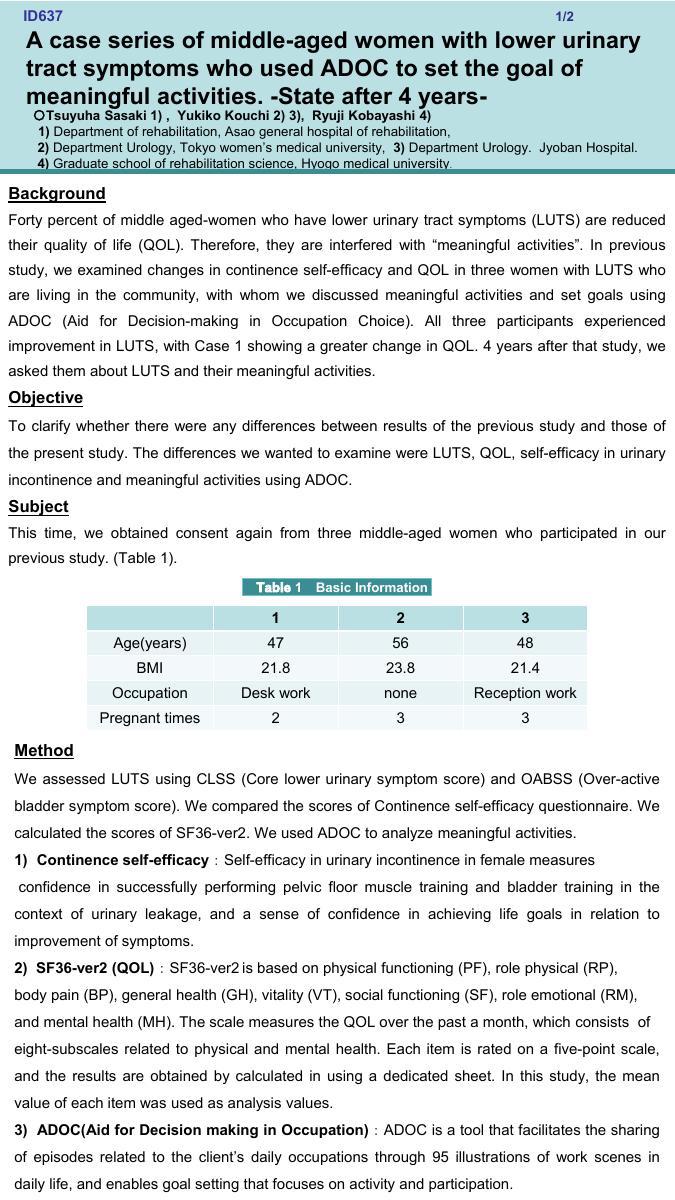
Background: In previous study, we examined the change in continence self-efficacy and QOL in three women with LUTS(Lower Urinary Tract Symptoms) living in the community, who were interviewed about meaningful activities and set goals using ADOC (Aid for Decision-making in Occupation Choice). All three experienced LUTS improvement, with Case 1 showing higher QOL change. After 4 years, we asked them about LUTS and their meaningful activities.
Ethical Considerations and COI: Ethical guidelines were explained, and consent was obtained. Approved by Ethics Review Committee of national network Association for Comfortable Urination. We don’t have COI.
Methods: We assessed LUTS using CLSS (Core lower urinary symptom score) and OABSS (Over-active bladder symptom score). We compared the scores of Continence self-Efficacy Questionnaire. We were calculated the score of SF36-ver2. We used ADOC to analyze meaningful activities.
Results: Case 1 had SUI(Stress Urinary Incontinence) but improved QOL with jogging towards a marathon. Case 2’s LUTS nearly disappeared, and she actively participated in neighborhood activities. Case 3 had occasional SUI but continued Kendo. The SF-36v2 showed an improvement rate of 6.99% in Case 1, 5.86% in Case 2, and 2.66% in Case 3.
Conclusion: All three participants maintained meaningful activities. They faced their conditions positively, because they understood their states of LUTS. Targeting meaningful occupation leads to long-terms improvements in QOL. Consequently QOL improvement requires more than just symptom management. However, more cases are needed for generalization.