
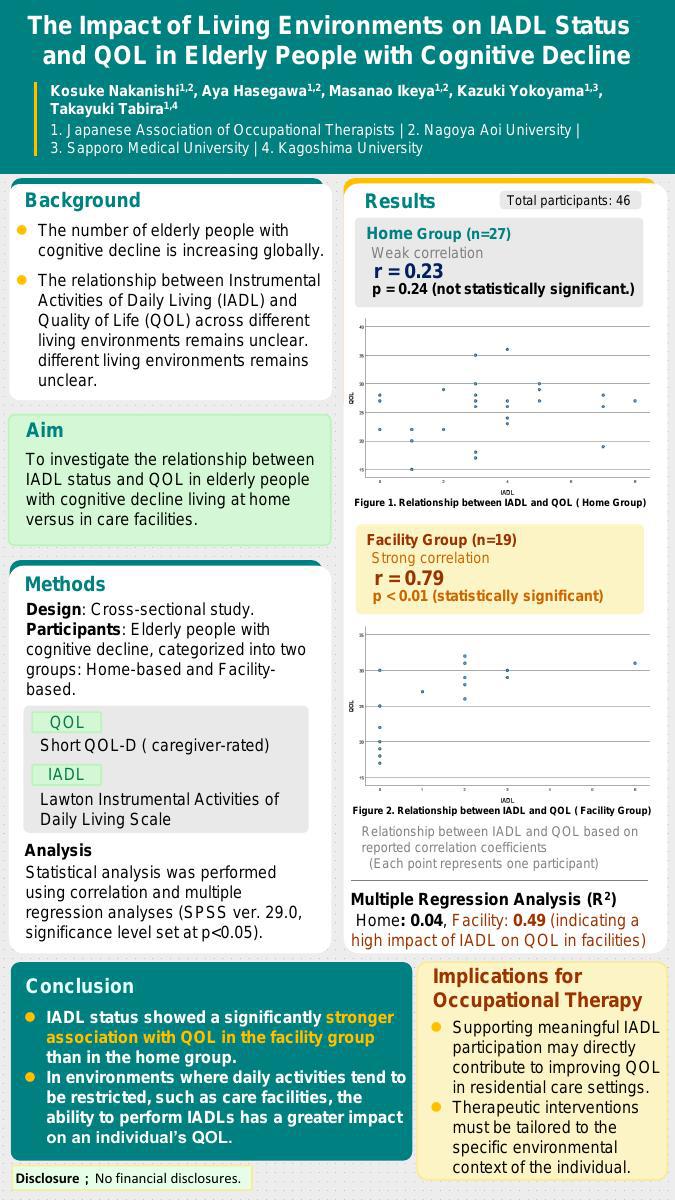
Introduction: In recent years, the number of elderly people with cognitive decline has been increasing globally with population aging (WHO, 2021). For residents in facilities, spending active leisure time has been shown to positively affect and ADL maintenance (Ogasawara et al., 2020). However, the impact of IADL intervention on QOL has not been fully clarified. This study aims to investigate the relationship between IADL status and QOL in elderly people with cognitive decline living at home or in facilities.
Methods: Using a cross-sectional design, this study targeted elderly people with cognitive decline living at home or in facilities. Lawton IADL was used to measure IADL, and short QOL-D was used by caregivers to assess QOL. Participants were divided into home and facility groups, and correlation and multiple regression analyses were performed between IADL and QOL. Statistical analyses were conducted using SPSS ver.29.0, with a significance level of 5%.
Results: The study included 46 participants (31 females: 86.4±6.8 years, 15 males: 82.1±5.8 years), with 27 in the home group and 19 in the facility group. The correlation between IADL and QOL was r=0.23 (p=0.24) in the home group and r=0.79 (p<.01) in the facility group. Multiple regression analysis showed R²=0.04 (p=0.30) in the home group and R²=0.49 (p<.01) in the facility group.
Conclusion: The results suggest that IADL status more strongly influences QOL in the facility group. In institutional environments where life is often restricted, there is room for occupational therapists to contribute to improving QOL of residents by providing IADL intervention.