
Introduction: Flow is the mental state of being completely immersed in an activity. Flow is likely to occur when there is a balance between an individual’s skills and the challenge. However, the association between flow state and their levels in occupational therapy remains unclear.
Objective: This study aimed to examine the relationship between the Flow State Scale for Occupational Tasks (FSSOT) and perceived levels of challenge and skill.
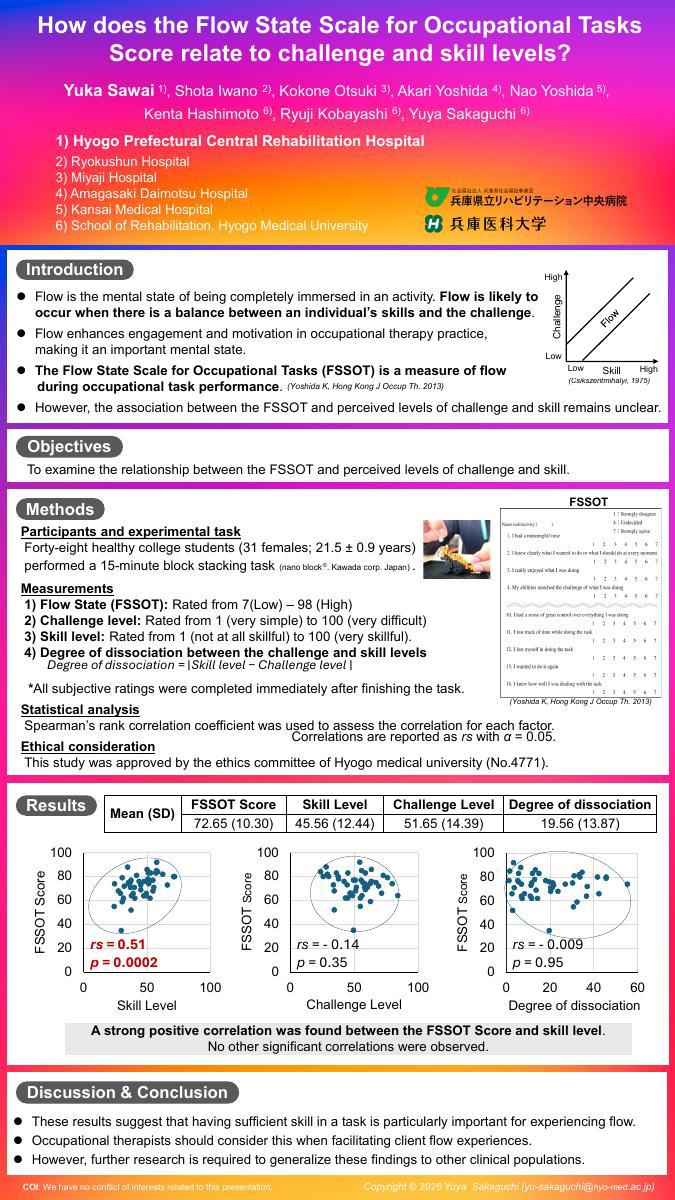
Methods: Forty-eight healthy college students performed a 15-minute block task. The flow state during the task was assessed using the FSSOT, consisting of 14 items and three factors (scores ranging from 7–98). The challenge level was rated from 1 (very simple) to 100 (very difficult), and the skill level was rated from 1 (not at all skillful) to 100 (very skillful). Additionally, the degree of dissociation between the challenge and skill levels was calculated as the absolute difference between the two scores. The Spearman's rank correlation coefficient was used for statistical analysis. Informed consent was obtained from all the participants prior to the study.
Results: Correlation analysis revealed a significant positive correlation between the FSSOT and skill level (rs = 0.51, p < 0.001). No other significant correlations were observed (p ≥ 0.05).
Conclusion: These results suggest that having sufficient skill in a task is particularly important for experiencing flow. Occupational therapists should consider this when facilitating client flow experiences. However, further research is required to generalize these findings to other clinical populations.