
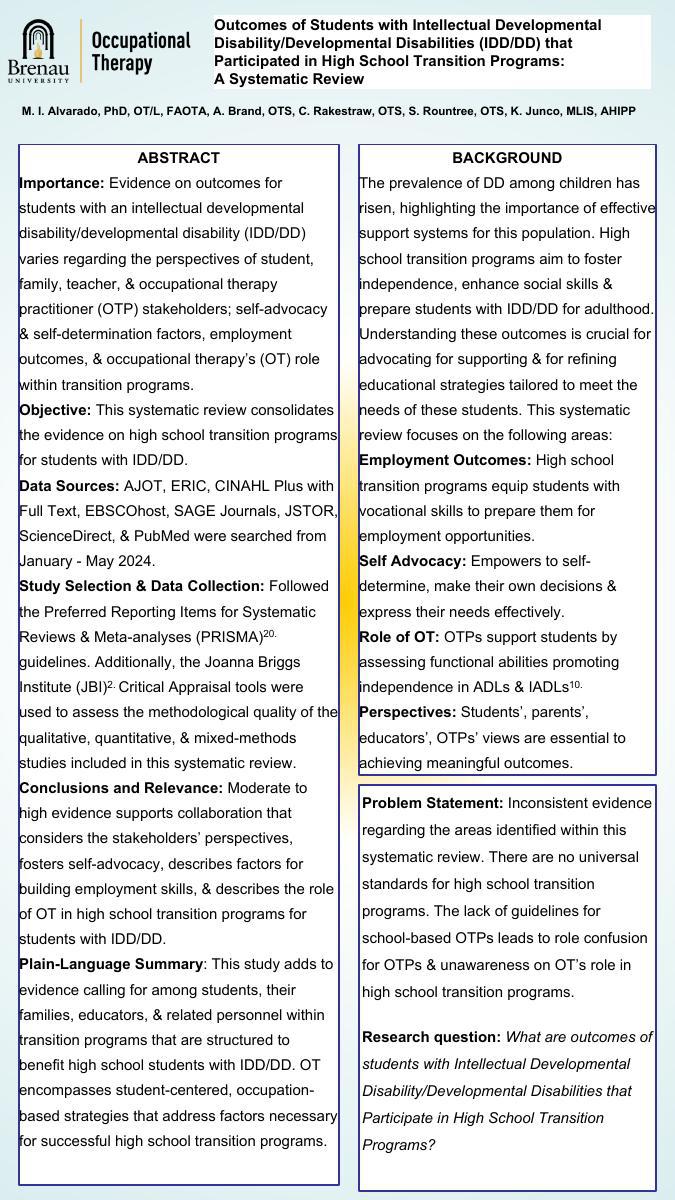
Introduction / Rationale: Evidence on outcomes for students with an intellectual developmental disability and developmental disability (IDD/DD) varies. Influencing factors include the perspectives of student, family, teacher, occupational therapy practitioner (OTP) stakeholders, transition program objectives such as self-advocacy, self-determination, pre-employment and employment experiences, as well as occupational therapy’s (OT) role within transition programs.
Objectives: This systematic review consolidates the evidence on high school transition programs for students with IDD/DD.
Methods / Approach: Data Sources from AJOT, ERIC, CINAHL Plus with Full Text, EBSCOhost, SAGE Journals, JSTOR, ScienceDirect, and PubMed were searched from January through May 2024.
Study Selection and Data Collection: Researchers selected articles selected for this systematic review by followed the Preferred Reporting Items for Systematic Reviews and Meta-analyses (PRISMA) guidelines. Additionally, Joanna Briggs Institute (JBI) Critical Appraisal tools were used to assess the methodological quality of the qualitative, quantitative, and mixed-methods studies included in this review. These methods allowed us to assess the trustworthiness and applicability of the findings within the articles we reveiwed.
Results / Practice Implications: Moderate to high evidence supports the importance of collaboration that considers the stakeholders’ perspectives, fosters self-advocacy, describes factors for building employment skills, and describes the role of OT in high school transition programs for students with IDD/DD.
Conclusion / Contribution to the occupational therapy profession: This systematic review provides evidence indicating high school transition programs for students with IDD/DD are comprised of interrelated factors. These include strong collaboration among stakeholders based on their perspectives, high school transition programs systematically designed to provide strategies that build the students’self-determination and self-advocacy skills. Occupational therapy’s role in transition programs involves generative student-centered, occupation-based approaches necessary for success after high school.