
Introduction: Religions have significant presence in many societies. Not only spiritual importance, but it might also have social welfare function. In Thailand, it is well-known that Buddhism monks and temples work for social good historically. We had a comprehensive study focusing on one of such temples.
Objectives: This study aims to consider potential roles of religions in community-based occupational therapy through exploring activities by a specific Buddhism temple.
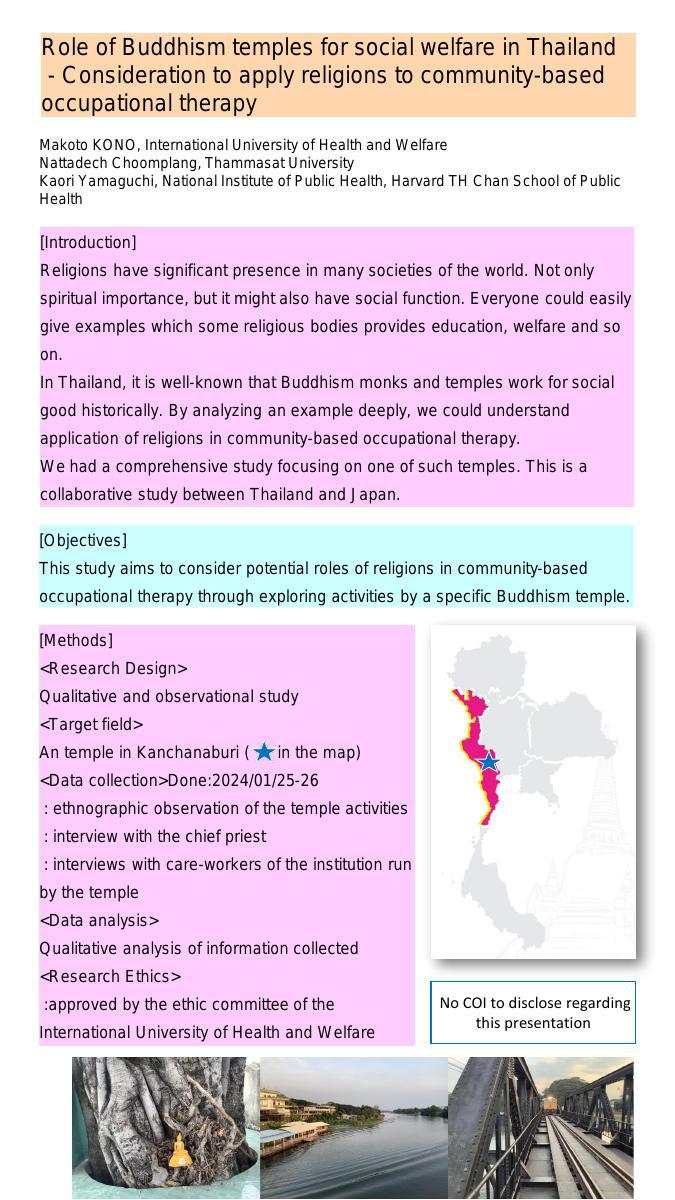
Methods: We had qualitative analysis of information collected through ethnographic observation of the temple activities, interview with the chief priest, and interviews with care-workers of the institution run by the temple. The study is approved by the ethic committee of the International University of Health and Welfare.
Results: The temple run a nursing home, and additionally provides places for activities of elderly clubs. The home had 128 residents as of the research day, and many of them were referred by hospitals due to no relative caring of them. On the other hand, hospitals provided regular medical supports for the home. The temple received plenty donation such as money, foods, and daily necessities including diapers, and the home depended on it. Most of care-workers started to work there based on the connection with the chief priest, and motivated by relationship with residents and their aspiration as care-worker.
Conclusion: The temple had a significant role as a focal point in community. It doesn’t come from religion directly, but surely reflects religious presence in society. We recommend consideration of religious resources in community-based occupational therapy.