
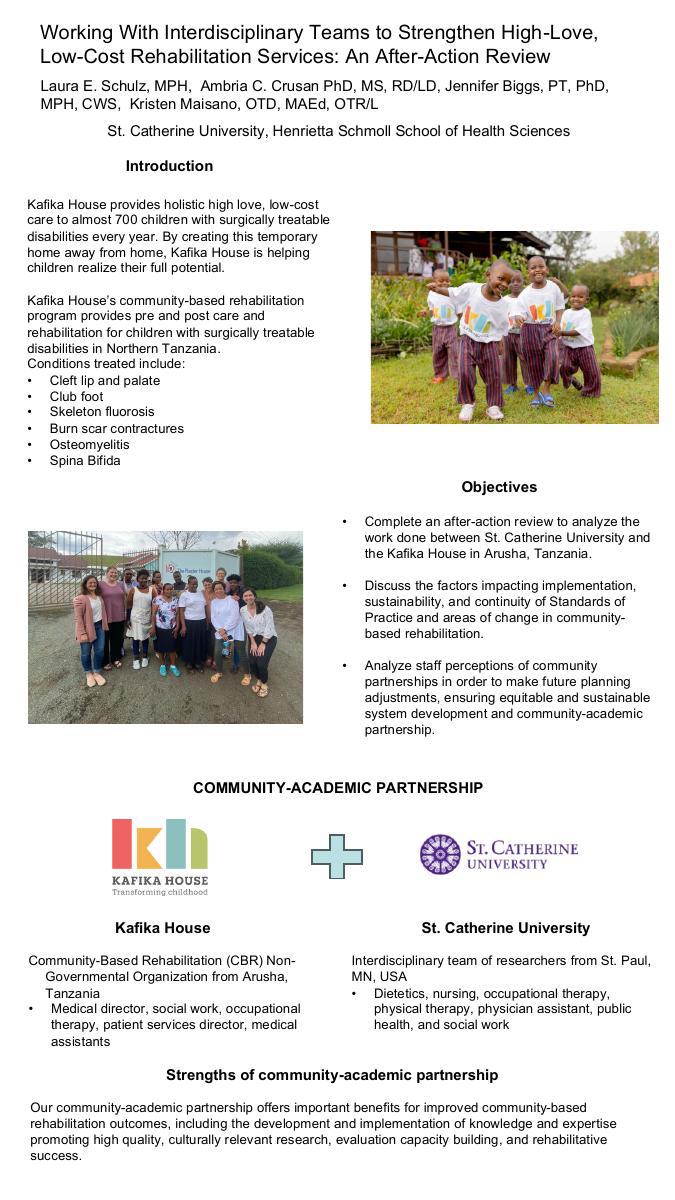
Kafika House provides holistic high love, low-cost care to almost 700 children with surgically treatable disabilities every year. By creating this temporary home away from home, Kafika House is helping children realize their full potential. With a goal of a world where children do not have to live with treatable disabilities, Kafika House saw the need to:
Objectives:
Complete an after-action review to analyze the work done between St. Catherine University and the Kafika House in Arusha, Tanzania.
Discuss the factors impacting implementation, sustainability, and continuity of Standards of Practice and areas of change in community-based rehabilitation.
Analyze staff perceptions of community partnerships in order to make future planning adjustments, ensuring equitable and sustainable system development and community-academic partnership.
Approach: A mixed methods approach included interviews, observations, and surveys to understand the level of buy-in from members of the team
Results: The following measures can be taken to ensure sustainability of monitoring and evaluation:
Provide culturally-relevant hands-on training supports implementation and continuity of outcome measurement
Expanding decision-making, streamlining internal communication cycles and increasing staff buy-in of evaluation processes strengthens implementation
Staff access to standardized resources supports continuity and sustainability of outcome measurement
Empowering all involved with capacity-building tools provides continuous, transparent, and all-encompassing evaluation
Conclusion: Multi-directional and transparent communication is required in the implementation of multiple evaluative measures simultaneously, requiring systems to be in place prior to the formation of the process to ensure the sustainability of monitoring and evaluation.