
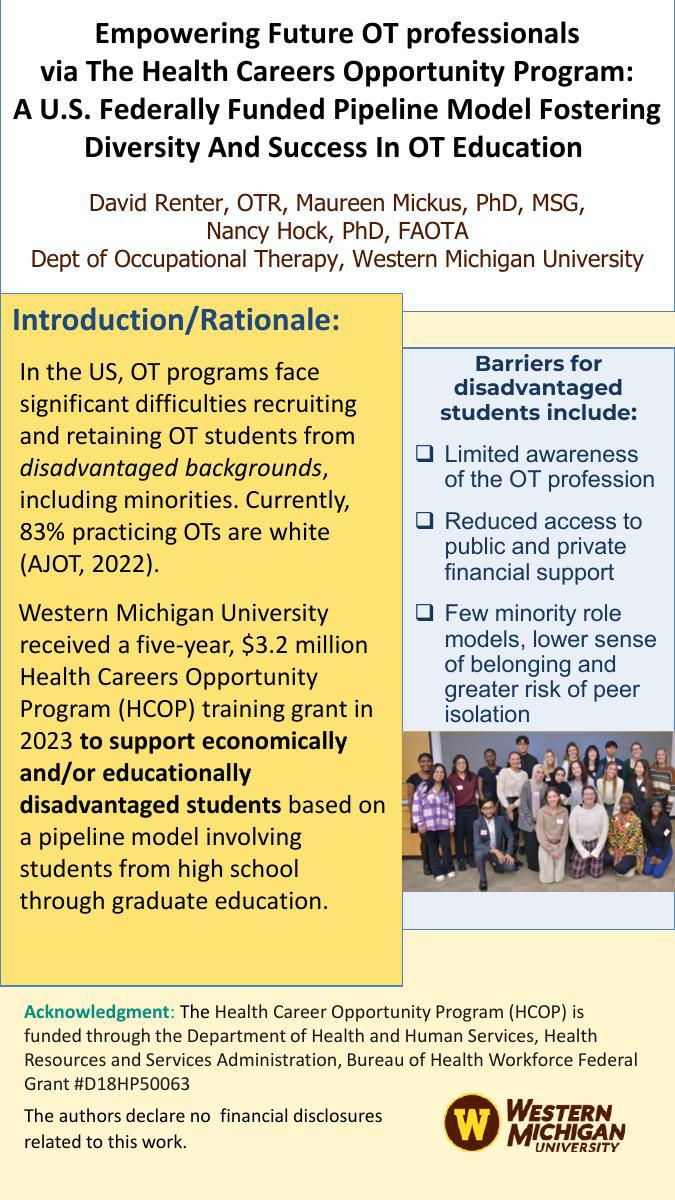
Introduction / Rationale: Recruiting and retaining OT students from disadvantaged backgrounds is challenging due to limited awareness of the profession, underrepresentation of minorities, and feelings of isolation. High education costs further hinder access. In 2023, Western Michigan University received a five-year, $3.2 million Health Careers Opportunity Program (HCOP) training grant to support economically disadvantaged students based on a pipeline model involving students from high school through graduate education.
Objectives: Program objectives include: 1) address financial hardship for economically/educationally disadvantaged students 2) diversify the OT workforce; 3) ensure academic success; and 4) provide clinical training opportunities with underserved populations.
Methods / Approach: HCOP employs a multi-faceted strategy supporting students in OT. Key components include financial scholarship, case management, structured NBCOT preparation, mentoring, and functional anatomy sessions. This program introduces high school and undergraduate students to the profession through a Summer Academy and Saturday workshops, offering exposure to OT practice and career exploration.
Results / Practice Implications: HCOP supported 52 students during the first year and an additional 67 in year two. All awardees were “first-generation” students from economically or educationally disadvantaged backgrounds. Of the first cohort of HCOP OTD graduates, 83% passed the NBCOT exam and secured employment within three months. Racial and ethnic minority students made up a significant portion of participants across HCOP programs: 48% of OTD students, 60% of Summer Academy attendees, and 28% of Saturday high school students from diverse backgrounds.
Conclusion / Contribution to the occupational therapy profession: Providing financial and academic support represents an important approach for increasing the heterogeneity and equity of the OT profession and ensuring career readiness for disadvantaged students.