
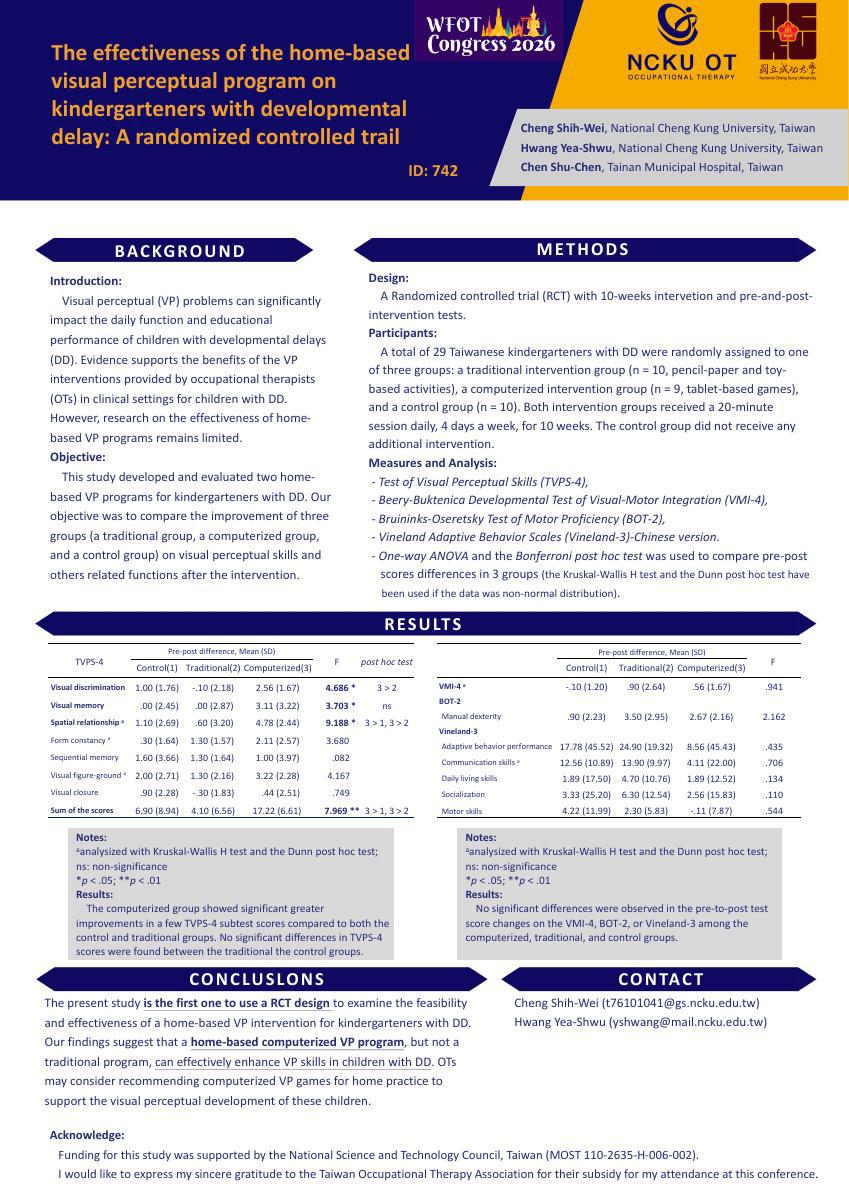
Introduction / Rationale: Visual perceptual (VP) problems can significantly impact the daily and educational activities of children with developmental delays (DD). Evidence supports the benefits of the VP interventions provided by occupational therapists (OTs) in clinical settings for children with DD. However, research on the effectiveness of home-based VP programs remains limited.
Objectives: We developed and evaluated the effectiveness of two types of home-based VP programs, traditional and computerized, for kindergarteners with DD.
Methods / Approach: Twenty-nine kindergarteners with DD were randomly assigned to a traditional group, a computerized group, or a control group. The intervention groups participated in 20-minute daily VP activities (either tablet-based games or pencil-paper/toy activities), four days a week for 10 weeks. The control group received no additional intervention beyond their regular intervention. Pre- and post- assessment included VP, visual-motor integration (VMI), fine-motor, and adaptive behavior tests.
Results / Practice Implications: The computerized intervention group showed significant improvements in VP scores compared to both the control and traditional intervention groups. However, no significant difference was observed between the traditional intervention and control group. Additionally, the two intervention programs did not yield additional benefits in the VMI, fine-motor, and adaptive behavior scores.
Conclusion / Contribution to the OT Profession: Our findings suggest that a home-based computerized VP program, but not a traditional program, can effectively enhance VP skills in children with DD. OTs may consider recommending computerized VP games for home practice to support these children’s visual perceptual development.