
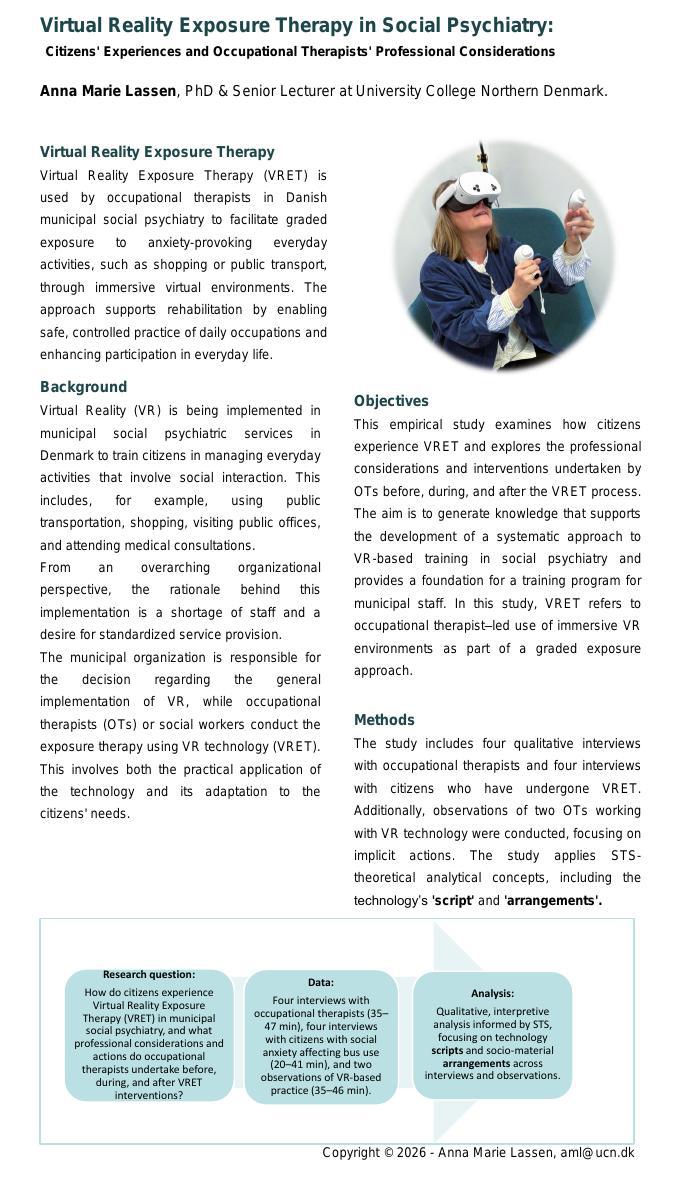
Introduction / Rationale
In Scandinavian countries, Virtual Reality (VR) is implemented in municipal social psychiatric services to train citizens to manage everyday activities involving social interaction. This includes, for example, using public transportation, shopping, visiting public offices, and attending medical consultations. The rationale behind this implementation from an overarching organizational perspective is a shortage of staff and a desire for standardized service provision.
The municipal organization is responsible for the decision regarding the general implementation of VR, while occupational therapists (OTs) or social workers conduct the exposure therapy using VR technology (VRET). This involves both the practical application of the technology and its adaptation to the citizens' needs.
Objectives
This empirical study examines how citizens experience VRET and explores the professional considerations and interventions undertaken by OTs before, during, and after the training process. The aim is to generate knowledge that supports the development of a systematic approach to VR-based training in social psychiatry and provides a foundation for a training program for municipal staff.
Methods / Approach
The study includes four qualitative interviews with OTs and four with citizens who have undergone VRET. Additionally, observations of two OTs working with VR technology were conducted, focusing on implicit actions. The study applies STS-theoretical analytical concepts, including the technology’s 'script' and 'arrangements'.
Results / Practice Implications
A summary of citizens' perceived opportunities and challenges in VRET.
OTs’ professional reflections and actions before, during, and after VRET.
Conclusion / Contribution to the occupational therapy profession
VRET can support citizens in managing everyday activities, and it is important to develop guidelines containing professional reflections on the possibilities and challenges of VRET.