
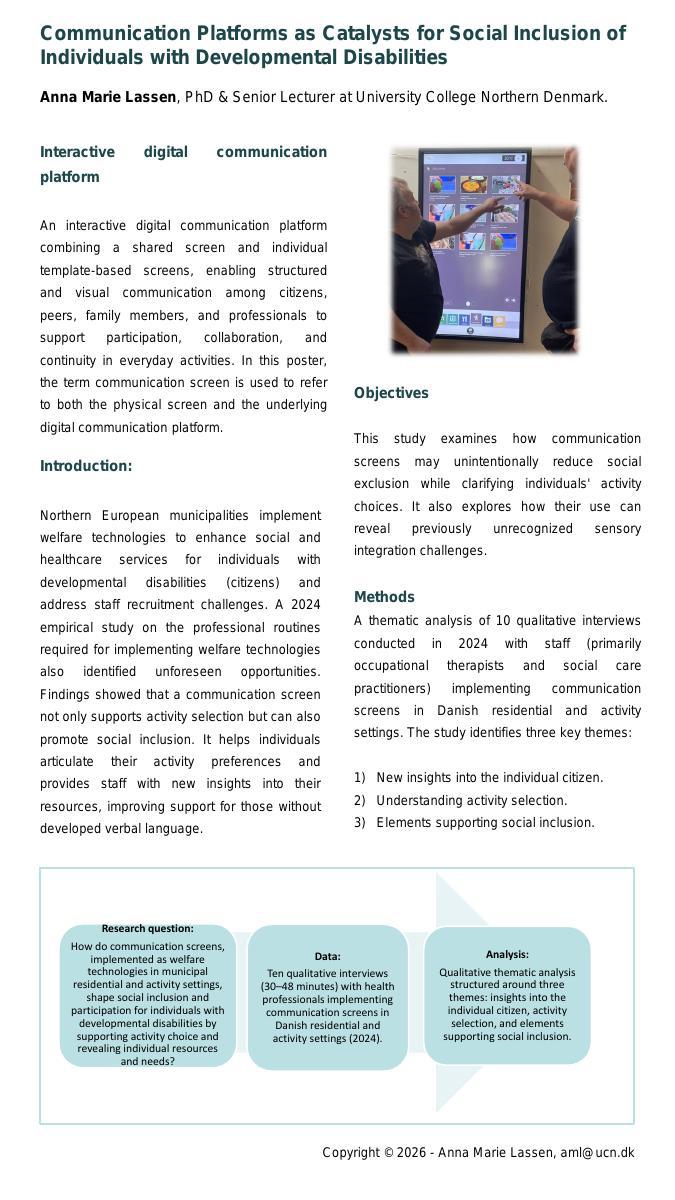
Introduction / Rationale
Northern European municipalities implement welfare technologies to enhance social and healthcare services for individuals with developmental disabilities (citizens) and address staff recruitment challenges. A 2024 empirical study on the professional routines required for implementing welfare technologies also identified unforeseen opportunities (carried out by the authors). Findings showed that a communication screen not only supports activity selection but can also promote social inclusion. It helps individuals articulate their activity preferences and provides staff with new insights into their resources, improving support for those without developed verbal language.
Objective
This study examines how communication screens may unintentionally reduce social exclusion inclusion while clarifying individuals' activity choices. It also explores how their use can reveal previously unrecognized sensory integration challenges.
Methods / Approach:
A systematic analysis of 10 qualitative interviews from 2024 with staff implementing communication screens in Danish residential and activity settings. The study identifies three key themes:
- New insights into the individual citizen.
- Understanding activity selection.
- Elements supporting social inclusion.
Results / Practice Implications
Key findings include:
- Staff must consider both expected and unexpected impacts of communication technology.
- Technology can uncover previously unknown individual citizen preferences and needs.
- Implementation is often an organizational decision, requiring alignment with both institutional goals and individual citizen needs.
Conclusion / Contribution to the occupational therapy profession
Communication screens can reduce social barriers and enhance participation for individual citizens with developmental disabilities. Staff must develop competencies to identify individual-centered opportunities and barriers related to the specific implemented technology to ensure that it not only supports organizational goals but also promotes the citizen's participation in activities.