
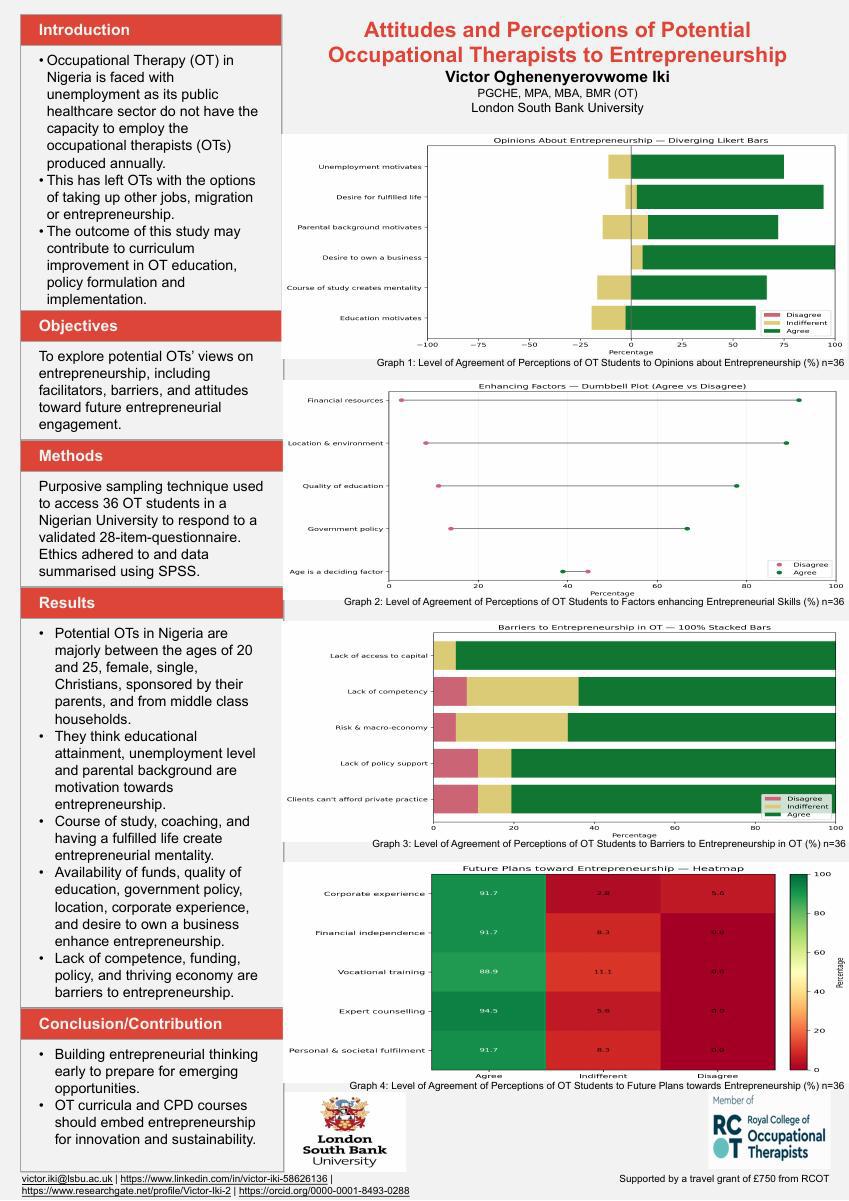
Introduction / Rationale: Occupational Therapy (OT) in Nigeria is faced with unemployment as its public healthcare sector do not have the capacity to employ the occupational therapists (OTs) produced annually. This has left OTs with the options taking up other jobs, migration or entrepreneurship. The outcome of this study may contribute to curriculum planning in universities, policies and its implementation.
Objectives: This study explores the perceptions of potential OTs about entrepreneurship, perceptions potential OTs have on factors enhancing entrepreneurial skills, perceptions on barriers to entrepreneurship in OT, and the attitudes of potential OTs to plans toward entrepreneurship.
Methods / Approach: A purposive sampling technique was used to access 36 consenting OT undergraduates in a Nigerian University to respond to a validated 28-item-questionnaire. Data were summarised using SPSS.
Results / Practice Implications: Potential OTs in Nigeria are majorly between the ages of 20 and 25, female, single, Christians, sponsored by their parents, and from middle class households. Potential OTs think educational attainment, unemployment level and parental background are motivation towards entrepreneurship; course of study, coaching, and having a fulfilled life create entrepreneurial mentality; availability of funds, quality of education, government policy, location, corporate experience, and desire to own a business enhance entrepreneurship; while lack of competence, funding, policy, and thriving economy are barriers to entrepreneurship.
Conclusion / Contribution to the occupational therapy profession: Potential OTs need to develop the entrepreneurial spirit before qualification/graduation. OT curriculum and continuous professional development programmes should have entrepreneurship courses/modules to equip OTs with entrepreneurial competencies.