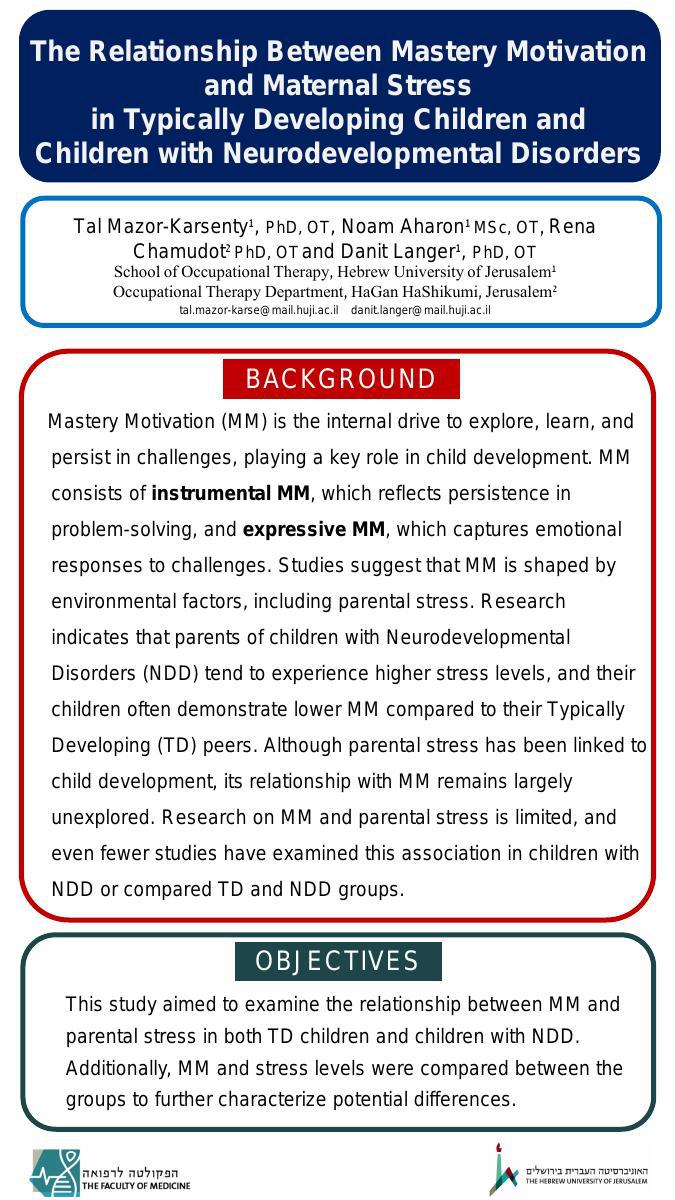
Introduction: Mastery Motivation (MM) is the internal drive to persist in challenges, playing a key role in child development. It includes instrumental (persistence) and expressive (affective) components. Environmental factors, such as stress, may influence MM. Children with neurodevelopmental disorders (NDD) often exhibit lower MM compared to typically developing (TD) children, and their mothers report higher stress.
Objectives: To examine maternal stress and MM in TD children and children with NDD, and explores their relationship.
Methods: This cross-sectional study included mothers of TD (n=89) and NDD children (n=38), who completed the Dimensions of Mastery Questionnaire, which assesses instrumental and expressive MM, along with a General Competence scale measuring perceived ability. The Parenting Stress Index-Short Form assessed stress across several domains.
Results: Mothers of NDD children reported higher stress and lower instrumental MM and general competence, with no differences in expressive MM. Concerning instrumental MM domains, in the TD group, stress domains linked most strongly to lower social persistence, with cognitive persistence also correlating. In NDD children, stress subscales were associated with reduced motor and cognitive persistence. Expressive MM showed minimal correlations in the TD group only. General competence showed negative correlations with all stress domains in the NDD group.
Conclusion: These findings emphasize the relationship between stress and MM, suggesting that OT interventions should consider targeting both.
