
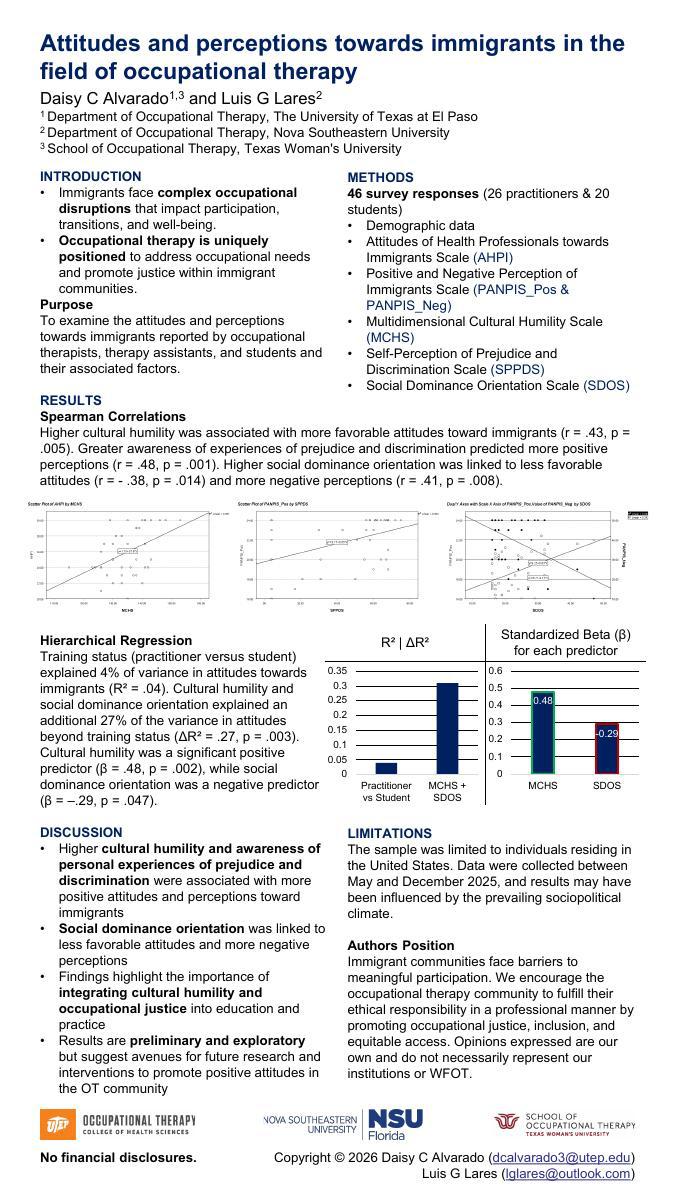
Introduction / Rationale: Immigrants experience complex and multidimensional occupational disruptions that benefit from specialized care and support. In response to the increasing present needs of immigrants globally, occupational therapy has been explored and identified as a field for addressing occupational needs, transitions, and justice in the immigrant community secondary to its reflexive practice and diversity and flexibility in roles.
Objectives: This study examined the attitudes and perceptions towards immigrants reported by occupational therapists, therapy assistants, and students and their associated factors (i.e., demographics, cultural humility, self-perceived prejudice and discrimination, and social dominance).
Methods / Approach: Survey methods were utilized to gather quantitative data through purposive sampling of participants from social media, healthcare organizations, and academic institutions. Participants completed the Attitudes of Health Professionals towards Immigrants Scale, Positive and Negative Perception of Immigrants Scale, Multidimensional Cultural Humility Scale, Self‑Perception of Prejudice and Discrimination Scale, and Social Dominance Orientation Scale. Multiple regression analyses, t-tests, and correlations were conducted to evaluate relationships between measures and differences based on demographic information.
Results / Practice: Preliminary analysis of 100 surveys revealed significant correlations and predictive capacity between positive perceptions and the multiple dimensions of cultural humility. Age, gender, ethnicity, and sociopolitical beliefs were analyzed as moderators. No significant differences between students and practitioners were identified across constructs.
Implications Conclusion / Significance to the Occupational Therapy Profession: Results suggest cultural humility relates to positive attitudes and perceptions toward immigrants and is moderated by demographic factors. By fostering cultural humility and being aware of personal biases, current and future occupational therapy practitioners can positively influence patient care and understanding of occupations in immigrant patients.