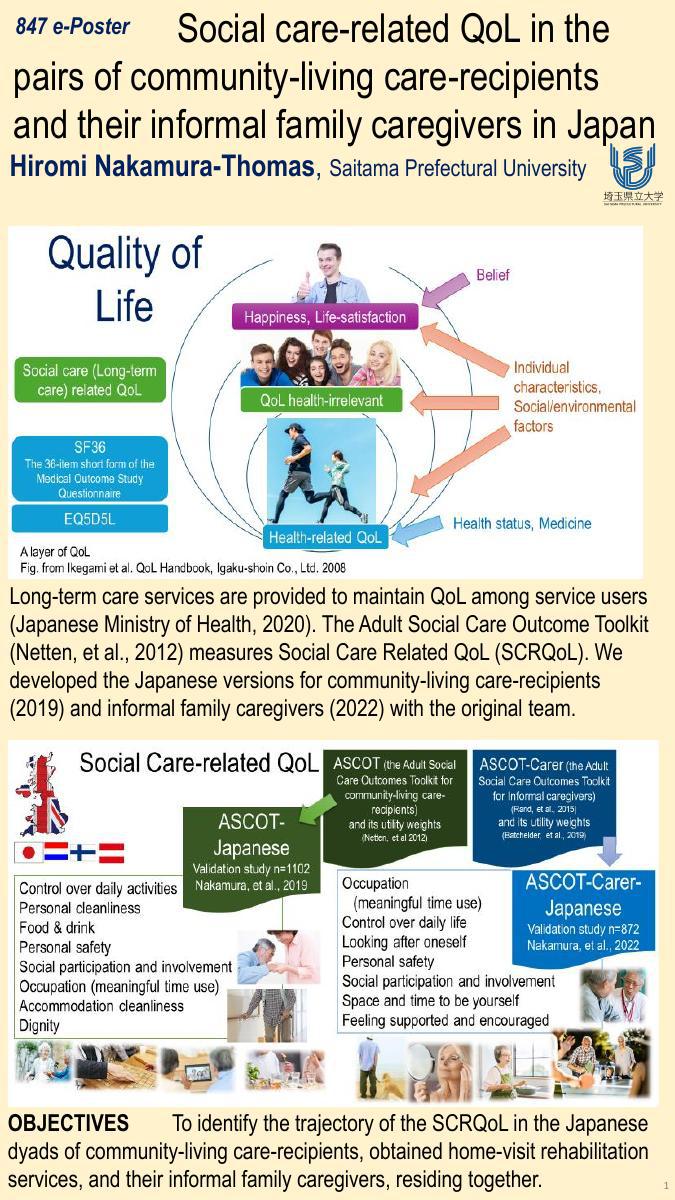
Introdcution: Long-term care services are provided to maintain QoL among service users (Japanese Ministry of Health 2020). The Adult Social Care Outcome Toolkit (Netten 2012) measures Social Care Related QoL (SCRQoL). We developed the Japanese versions for community-living care-recipients (2019) and for informal family caregivers (2022) with the original team.
Objectives: To identify the trajectory of the SCRQoL in the Japanese dyads of community-living care-recipients, obtained home-visit rehabilitation services, and residing informal family caregivers. Methods: We analyzed data from 81 dyads with no missing data. Responses to the two outcomes (2019, 2022) were converted in scores based on the Japanese-specific algorithms we developed (2020, 2022). For capturing the care-recipients’ objective functional states, we employed the Functional Independent Measure (FIM) and the Mini-Mental State Examination. Data were collected at the first home-visit rehabilitation service and a six-month period. We observed the s the trajectory of the SCRQoL and functional states. We calculated correlations of the SCRQoL between the dyads and correlations between the SCRQoL and functional states.
Results: Among the care-recipients, 52% was women, 74% was 75 years old and older, and 33% had stroke. Among the caregivers, 65% was women, 42% was 75 years old and older and 41% took care of husband. Both the care-recipients and the caregivers maintained the SCRQoL. The care-recipients maintained scores of the SCRQoL and the functional states. No correlation was observed in the SCRQoL between the dyads. The care-recipients’ FIM score was positively correlated with the caregivers’ SCRQoL at two periods.
Conclusion: The home-visit rehabilitation services may contribute to maintain their SCRQoL and functional states. Keeping functional independent level of care-recipients may be beneficial for caregivers' SCRQoL.
