
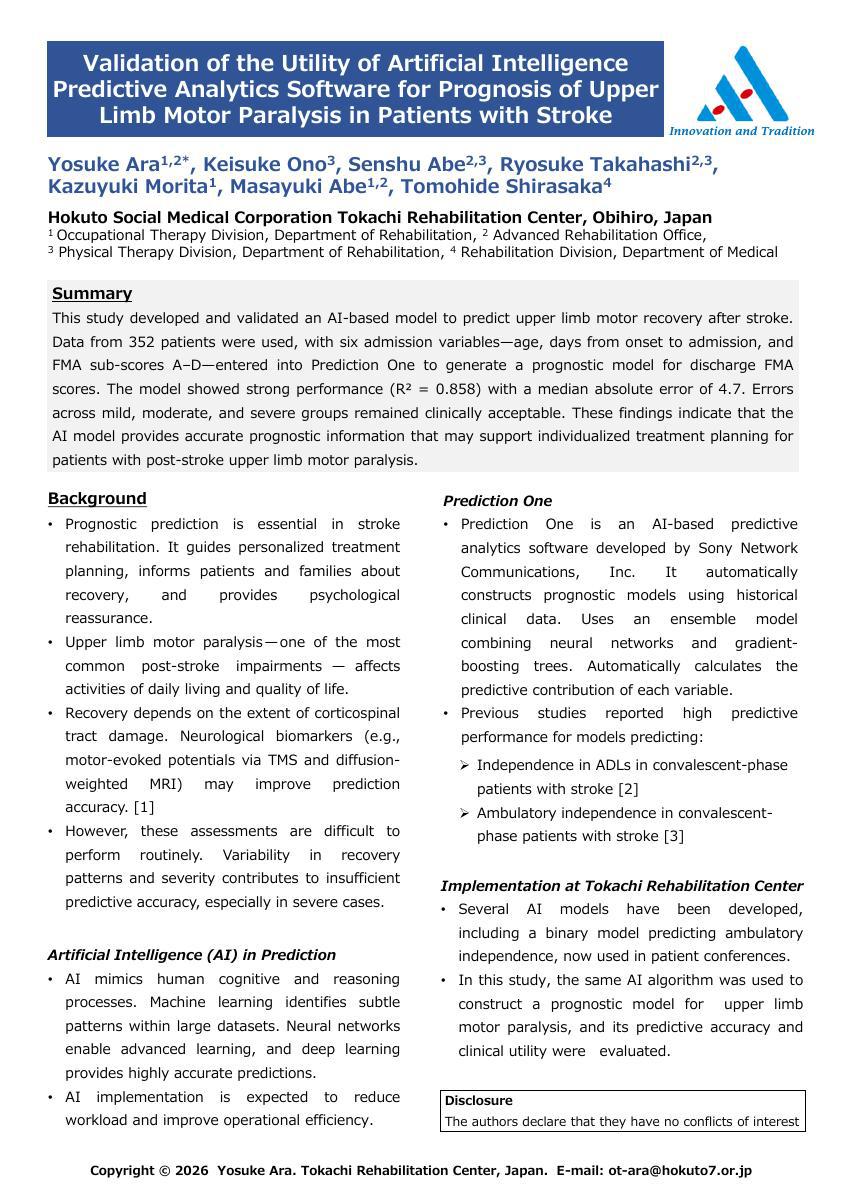
Introduction: Prognostic prediction is essential in stroke rehabilitation to determine personalized treatment plans for individual patients. In this study, we developed a prognostic model for upper limb motor paralysis after stroke using the artificial intelligence (AI) predictive analytics software Prediction One and evaluated its predictive accuracy and clinical utility.
Methods: The study included 352 stroke patients admitted to our center. They were randomly assigned into two equal groups: a training group and a validation group. Data from the training group (n=176) including six variables—age, days from onset to admission, and the Fugl-Meyer Assessment (FMA) sub-scores (A/B/C/D) at admission—were input into Prediction One to develop a numerical prediction model for the FMA score at discharge. The developed prognostic model was then evaluated using data from the validation group (n=176), and the predictive accuracy was assessed by calculating the median absolute error between predicted and actual outcomes.
Results: The coefficient of determination (R²) of the model was 0.858. The median absolute error between predicted and actual outcomes was 4.7 (interquartile range [IQR] = 1.6–9.4). The median absolute error stratified by FMA severity at admission was 3.5 (IQR = 1.6–7.7) for mild cases, 7.6 (IQR = 5.5–12.5) for moderate cases, and 4.5 (IQR = 1.4–12.4) for severe cases.
Conclusion: The predictive accuracy of the AI-based model was found to be within a clinically applicable range, suggesting its clinical utility in predicting upper limb motor recovery in stroke patients.