
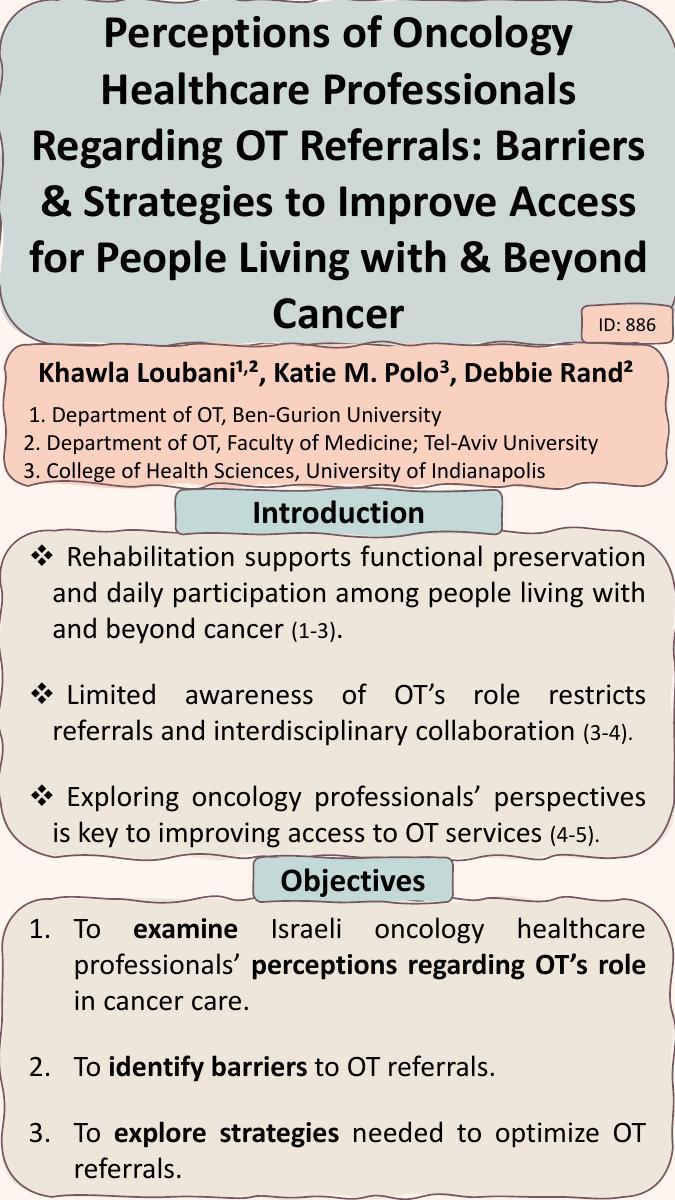
Introduction / Rationale:
Persons living with and beyond cancer (PLWBC) benefit from rehabilitation to mitigate functional decline and enhance daily participation. While occupational therapy (OT) interventions for PLWBC are effective, limited awareness of OT’s role in cancer care hinders service provision, referrals, and interdisciplinary collaboration. Exploring oncology healthcare professionals' perspectives provides critical insights into barriers and facilitators for OT referrals.
Objectives:
This study examined Israeli oncology healthcare professionals' perceptions of OT’s role in cancer care and identified resources needed to optimize referrals for PLWBC.
Methods / Approach:
A qualitative multiple case study design was used, incorporating focus groups with oncology healthcare professionals. Two researchers analyzed data using a grounded theory approach, while a third, independent researcher reviewed the findings to enhance reliability.
Results / Practice Implications:
Twenty-nine participants (social workers and oncology nurses) took part in six focus groups (five to six participants per group). Barriers to referral included:
- Limited knowledge of OT’s role and its connection to cancer-related functional challenges.
- Bureaucratic obstacles, such as the absence of formal referral protocols.
- Lack of OT presence in oncology clinics.
Participants suggested strategies to enhance referrals, including improving interdisciplinary collaboration between oncology teams and OTs (e.g., improving communication and collaborations between the interdisciplinary oncology team and OTs).
Conclusion / Contribution to the Occupational Therapy Profession:
OTs play a vital role in oncology rehabilitation, yet services remain underutilized. Implementing the suggested strategies can improve referral processes, strengthen interdisciplinary collaboration, and bridge gaps in cancer rehabilitation services.