
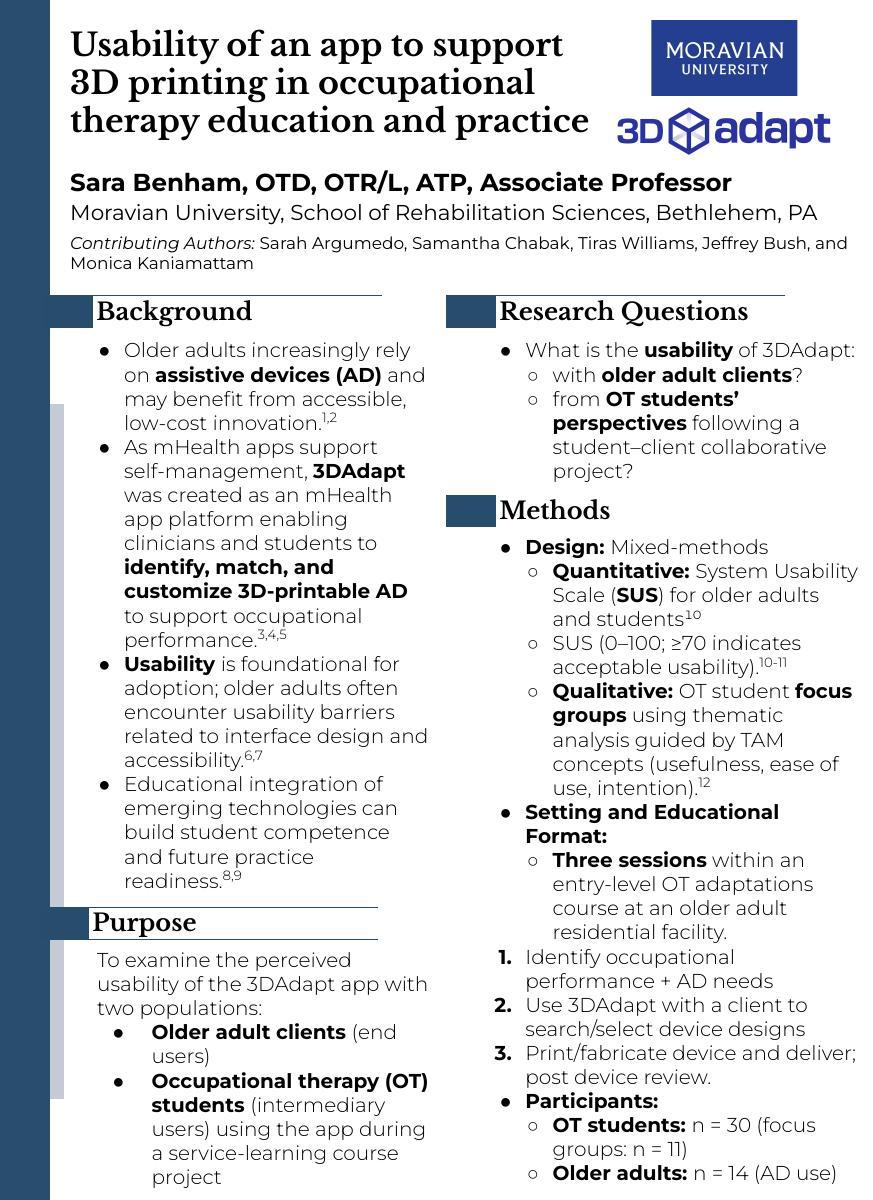
Introduction / Rationale: Finding 3D-printed assistive devices (ADs) can be overwhelming for students and clinicians when locating the appropriate AD for a specific client. This challenge led to the creation of the 3DAdapt app, requiring usability evaluations with potential users.
Objectives: To explore the usability of 3DAdapt through an occupational therapy (OT) student project delivering a 3D-printed AD to an older adult client.
Methods / Approach: A descriptive mixed methods study enrolled OT students and older adults from an independent-living community. Students collaborated with the older adult over three sessions using the app to deliver and assess 3D-printed ADs. Participants completed the System Usability Scale (SUS ≥ 70 is interpreted as usable), and OT students participated in focus groups to explore usability in occupation-focused AD delivery.
Results / Practice Implications: Students (n=30) found 3DAdapt to be usable (SUS average=80.42; SD=11.80), while older adults (n=14) reported lower usability (SUS average=64.64;SD=30.35). Thematic analysis revealed (1) the usefulness of 3D Adapt to OT is the communication of 3D printing; (2) the app was found to be easy due to familiarity, convenience, and simplicity, however, needs improvement in some areas; and (3) the intention to use the app may rely on initial engagement and the education provided.
Conclusion / Contribution to the occupational therapy profession: The app was usable among OT students; however, it requires updates to improve its usability for older adults. The findings of this study will be integrated into future app updates to improve usability and enhance awareness of 3D-printed AD to enhance participation.