
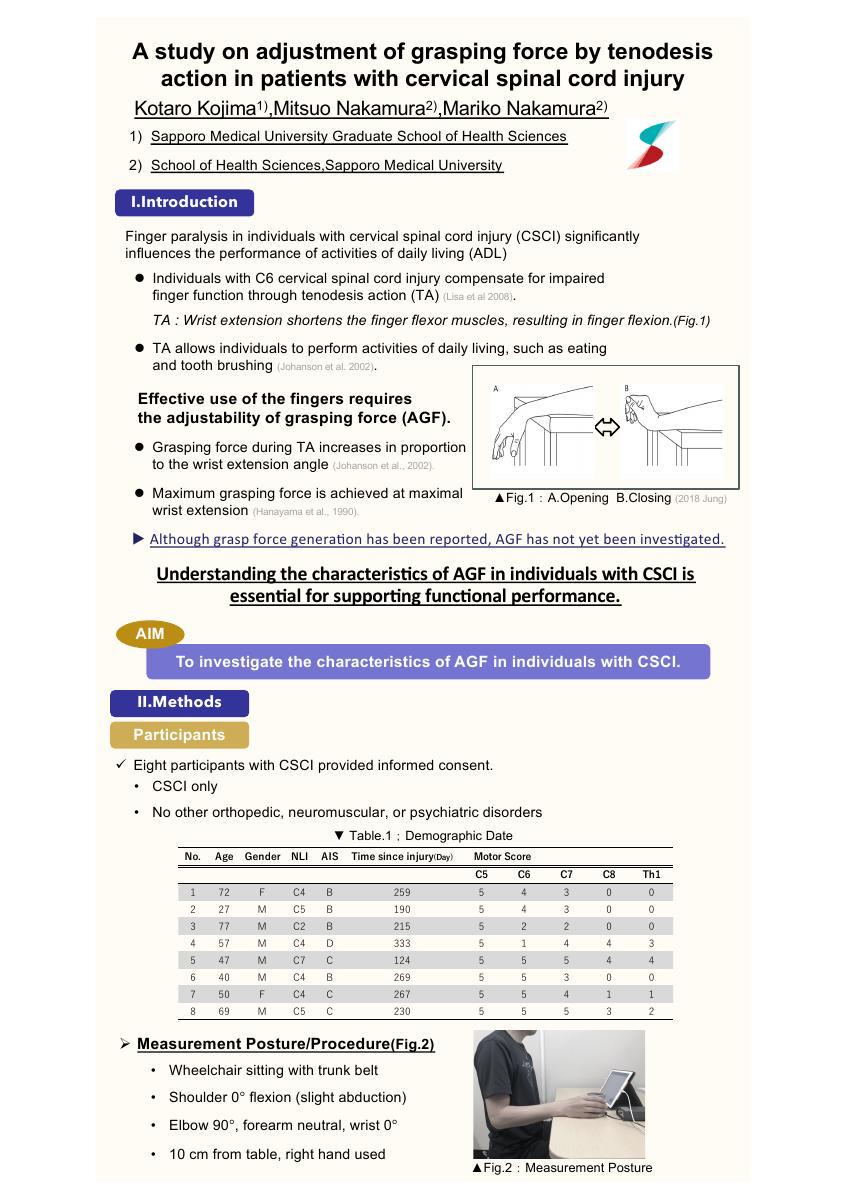
Introduction:
Many patients with cervical spinal cord injury (CSCI) experience significant loss of hand function and rely on tenodesis action(TA) as a compensatory strategy for grasping. TA enables individuals to manipulate objects by utilizing wrist joint motion to passively control finger movement. In daily activities, such as eating and self-care tasks, individuals with CSCI must use a variety of tools, requiring precise adjustability of grasping force (AGF) to ensure effective manipulation. Thus, understanding the characteristics of AGF in CSCI is essential for supporting functional performance in activities of daily living.
Objectives:
This study aimed to investigate the characteristics of AGF in individuals with CSCI.
Methods:
AGF was assessed in eight individuals with CSCI using the iWakka, a device designed to measure grasp force adjustment. The experimental task was a mountain task in which a compression phase to increase the grasping force and an keep phase to maintain that force were repeated, followed by a decompression phase to decrease the grasping force and repeat the keep phase.
Results:
Individuals with CSCI demonstrated higher AGF during the decompression phase and lower AGF during the compression phase. In all phases, the difficulty of AGF increased as the required grasping force level rose.
Conclusion:
The results of current study suggest that the grasping force generated by hand extensors is a possible factor of controling AGF in individuals with CSCI.These results highlight the need to consider the specific characteristics of AGF in CSCI when developing occupational therapy interventions aimed at improving hand function.