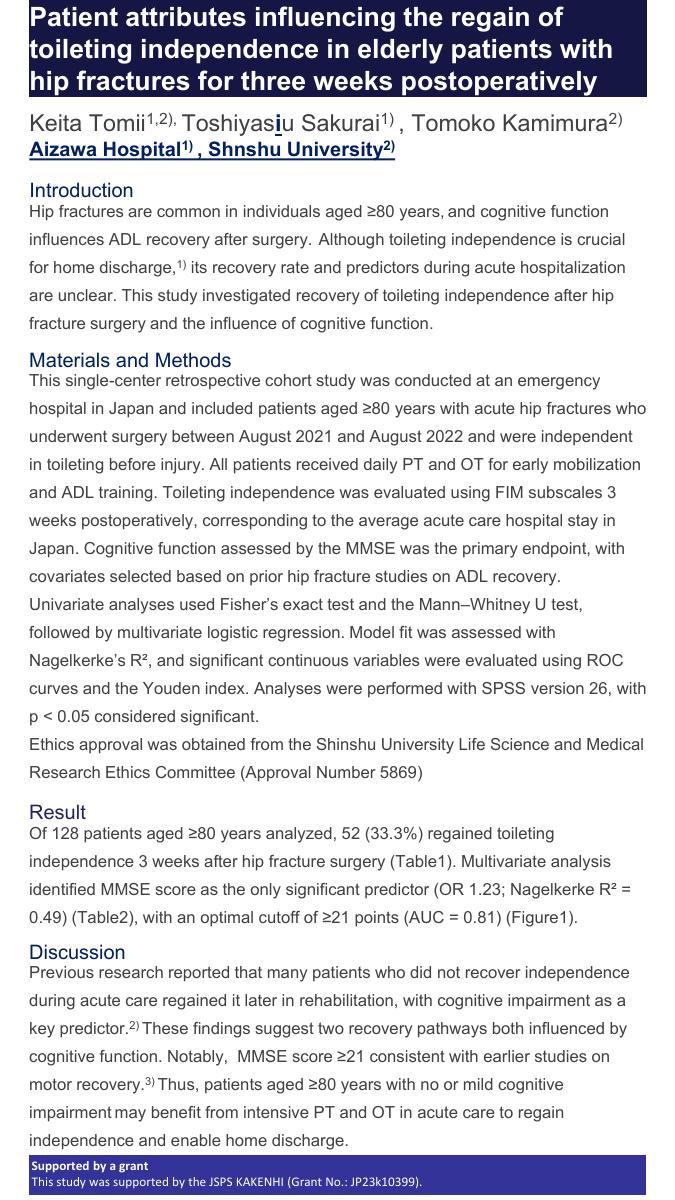
Introduction: The incidence of hip fractures increases in patients over 80 years of age. In Japanese acute care hospitals, the standard length of hospitalization following hip fracture surgery is approximately three weeks. Achieving independent toileting during hospitalization improves the likelihood of discharge to home. If we know early in the hospitalization process that the patient is likely to be independent in toileting at discharge, we can begin preparing the patient for discharge home sooner.
Objectives: To identify patient attributes that can be assessed early during hospitalization and are associated with regaining toileting independence within three weeks postoperatively in elderly hip fracture patients.
Methods: This study was retrospective study. The dependent variable was toileting independence at three weeks postoperatively. Independent variables included age, gender, comorbidities, fracture site, preoperative anemia, nutritional status, place of residence, pre-injury ambulatory ability, cognitive function at admission, and occurrence of postoperative delirium. Binomial logistic regression analysis was performed, and receiver operating characteristic curve analysis was used to determine cutoff values for variables associated with toileting independence.
Results: Among the study population, 51 patients (41.1%) achieved independent toileting. Cognitive function at admission, assessed using the Mini-Mental State Examination (MMSE), was the only attribute significantly associated with toileting independence (p<0.01). The cutoff MMSE score for predicting toileting independence was ≥ 17 points.
Conclusion: Cognitive function at admission was associated with regaining toileting independence for three weeks postoperatively in elderly hip fracture patients. This finding may serve as an indicator for facilitating smooth coordination toward discharge home.
