
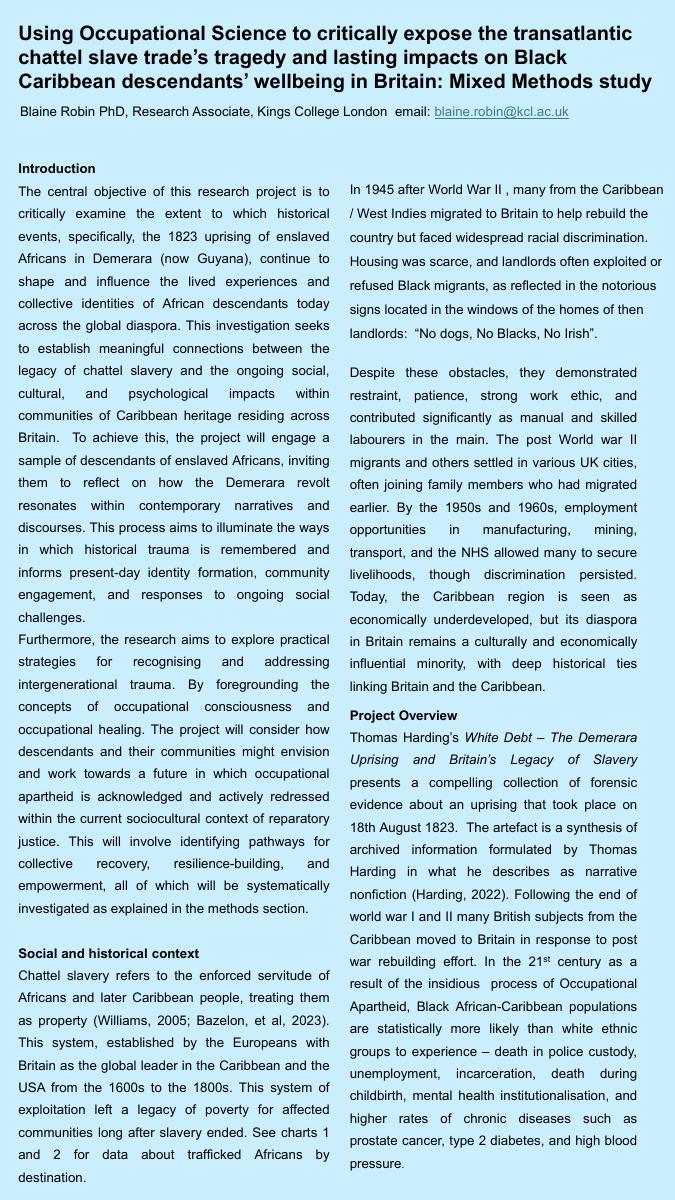
Introduction / Rationale: Chattel slavery refers to the forced servitude and ownership of Africans and later Caribbean people as property. The British system of plantation slavery in the Caribbean began in the 1600s and ended in 1838. Britain and the Caribbean remain inextricably linked socially, economically, politically, and historically. Several European nations, including France, Spain, Portugal, Sweden, Holland, Latvia (formerly Courland and Semigallia), and Denmark, participated in transatlantic chattel slavery. This involved the abduction and forced transportation of Africans to the Caribbean and the Americas in exchange for goods and commodities shipped to British ports such as London, Bristol, Liverpool, and Glasgow.
Objectives: This study explores the historical treatment of enslaved Africans and its impact on present-day African Caribbean communities. It also examines whether occupational healing can occur through the social inclusion of Black Caribbean voices in policy development across education, business, health, and media.
Methods / Approach: A mixed methods approach will be used, combining qualitative focus groups and a quantitative survey. Focus groups will generate themes for developing a structured questionnaire. A purposive sample of 100–200 health and social care professionals will participate in the survey.
Results / Practice Implications: Findings will enhance occupational therapists' awareness of the lasting trauma of transatlantic slavery on individuals and communities.
Conclusion / Contribution to Occupational Therapy: Occupational Science provides insight into the occupational injustices experienced under chattel slavery. Occupational therapists can apply these findings to support holistic healing frameworks across family life, social relationships, work, and community participation.