
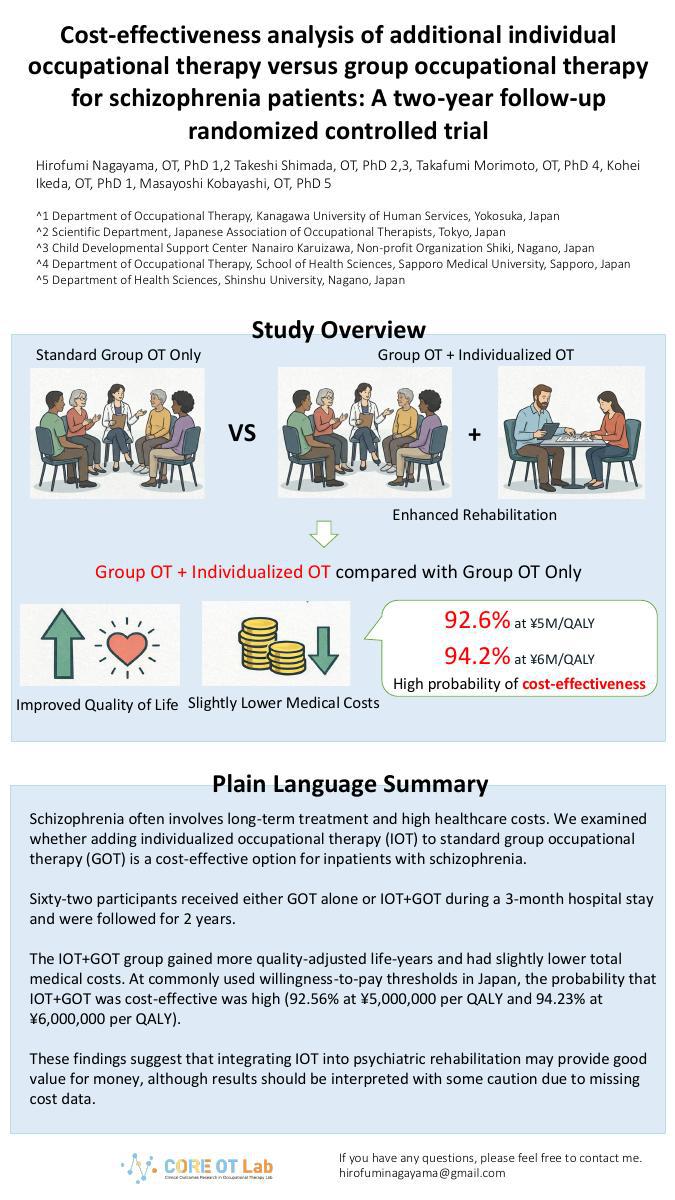
Introduction: Cognitive impairment in schizophrenia significantly affects functional outcomes and increases healthcare costs. This study evaluates the cost-effectiveness of additional individual occupational therapy (IOT) combined with group OT (GOT) compared to GOT alone.
Methods: A cost-effectiveness analysis was conducted alongside a multi-center randomized controlled trial in Japan. Patients with schizophrenia (n = 67) were randomized to receive additional IOT with GOT or GOT alone. Quality-adjusted life years (QALYs) were estimated from EQ-5D-5L utility scores at baseline, discharge (or 3 months post-admission), and 1 and 2 years post-admission. Medical costs, including hospitalization and post-discharge healthcare expenses, were assessed from the healthcare payer’s perspective. Missing data were handled using multiple imputation (MI), generating 50 imputed datasets. To account for uncertainty, 1,000 bootstrap resampling iterations were performed. The incremental cost-effectiveness ratio (ICER) was calculated, with willingness-to-pay (WTP) thresholds of 5 million and 6 million JPY/QALY.
Results: The ICER for IOT + GOT versus GOT alone was -3.3 million JPY/QALY (95% CI: -13.42 million to 6.62 million). Net monetary benefit (NMB) was 1,072,624 JPY at WTP = 5 million JPY/QALY and 1,228,992 JPY at WTP = 6 million JPY/QALY. The probability of IOT + GOT being cost-effective was 92.56% at WTP = 5 million JPY/QALY and 94.23% at WTP = 6 million JPY/QALY.
Conclusion: IOT combined with GOT demonstrates a high probability of being cost-effective compared to GOT alone for schizophrenia patients. These findings support its integration into routine care, but further long-term studies are needed to confirm its economic sustainability and clinical effectiveness.