
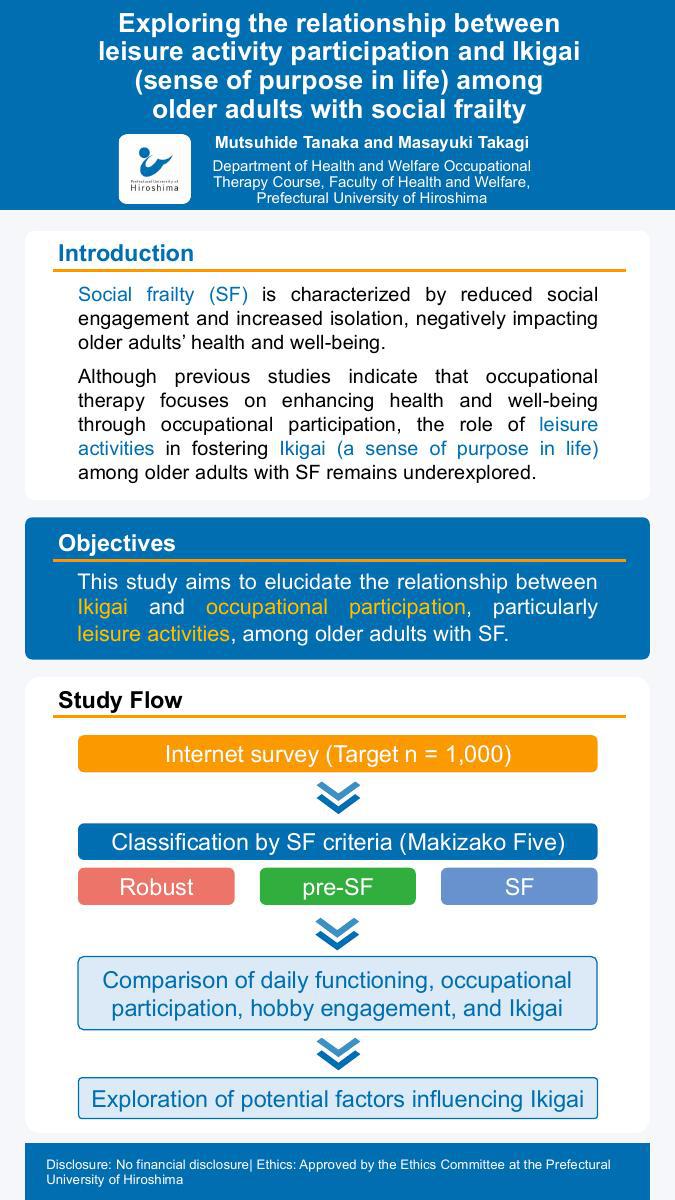
Introduction: Social frailty (SF) is characterized by reduced social engagement and increased isolation, negatively impacting older adults’ health and well-being. Although previous studies indicate that occupational therapy focuses on enhancing health and well-being through occupational participation, the role of leisure activities in fostering Ikigai (a sense of purpose in life) among older adults with SF remains underexplored.
Objectives: This study aims to elucidate the relationship between Ikigai and occupational participation, particularly leisure activities, among older adults with SF.
Methods: An internet survey of 1,000 older adults (65–85 years, mean age: 74.1 ± 5.5) stratified by gender and age was conducted. Participants were classified into robust, pre-SF (PSF), and SF groups using the Makizako five criteria. They completed questionnaires on daily functioning, Ikigai (Ikigai-9), occupational participation (Self-Completed Occupational Performance Index, SOPI), and hobby engagement. Multiple regression analyses were conducted to identify factors influencing Ikigai. This study was approved by the Ethics Committee at the Prefectural University of Hiroshima.
Results: The Kruskal-Wallis test showed that the SF group had significantly lower daily functioning, Ikigai-9, SOPI, and hobby engagement compared to the other groups. Regression analyses indicated that leisure activity participation, as measured by SOPI, was positively associated with Ikigai-9 in both the SF and PSF groups but not in the robust group. Hobby engagement showed a significant positive correlation with Ikigai-9 across all groups.
Conclusion: These findings suggest that occupational therapy should prioritize promoting leisure activities to enhance Ikigai and prevent SF, particularly among older adults at risk of developing SF.