
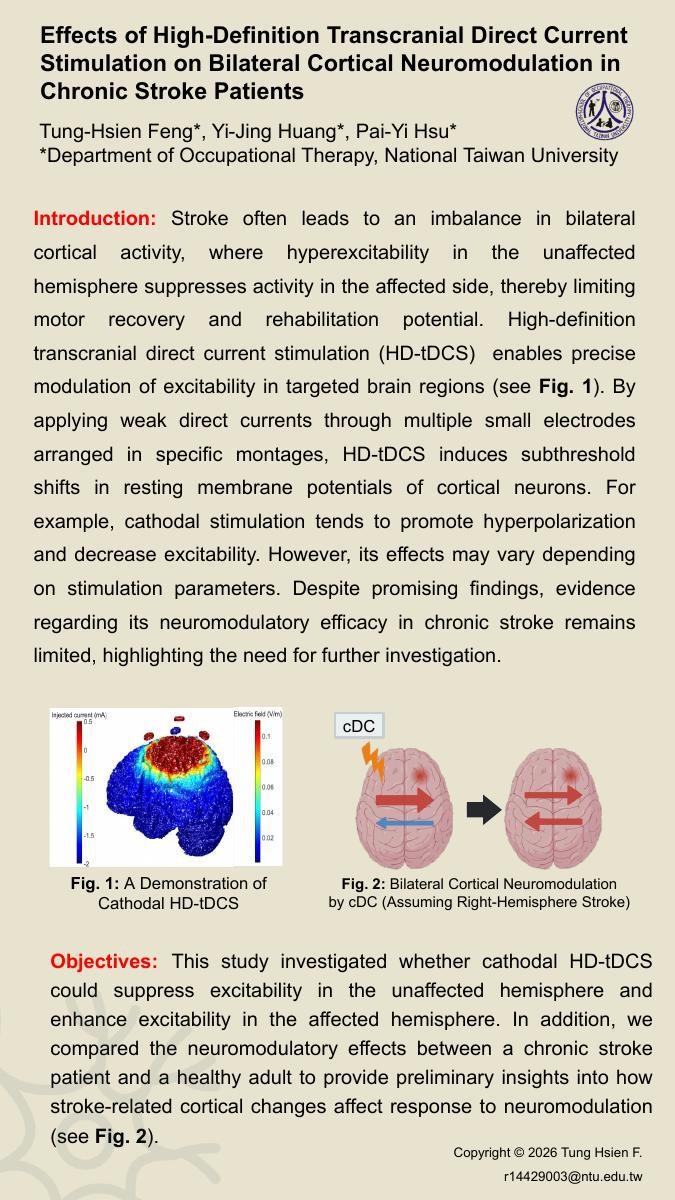
Introduction: Stroke disrupts interhemispheric balance, with excessive excitability in the unaffected hemisphere and inhibition in the affected hemisphereside, which reduces rehabilitation potential. High-definition transcranial direct current stimulation (HD-tDCS) precisely modulates cortical excitability, but its effects may vary depending on current characteristics.
Objectives: This study aimed to investigate whether cathodal direct current (cDC) can suppress cortical excitability in the unaffected hemisphere and enhance excitability in the affected hemisphere of stroke patients. Additionally, the neuromodulatory effects between stroke patients and healthy adults were compared.
Methods: This study included a 53-year-old female with a right hemisphere stroke (≥6 months post-stroke) and a 58-year-old healthy female, both of whom were right-handed. Baseline motor-evoked potentials (MEPs) were measured bilaterally before applying 10 minutes of 2mA cDC stimulation over the left primary motor cortex. MEPs were recorded bilaterally for 120 minutes post-stimulation.
Results: cDC stimulation of the unaffected hemisphere suppressed its cortical excitability. The affected hemisphere showed mild suppression in the first 30 minutes but exhibited increased excitability after 90 minutes post-stimulation. The healthy adult displayed a similar trend, though with stronger inhibitory and excitatory effects.
Conclusion: Our findings support that cDC over the unaffected hemisphere in stroke patients modulates bilateral cortical excitability, initially suppressing the unaffected side and enhancing the affected side after 90 minutes. While both groups exhibited similar neuromodulatory effects following HD-tDCS, the healthy adult showed a more pronounced response, potentially due to reduced neural sensitivity in stroke patients.