
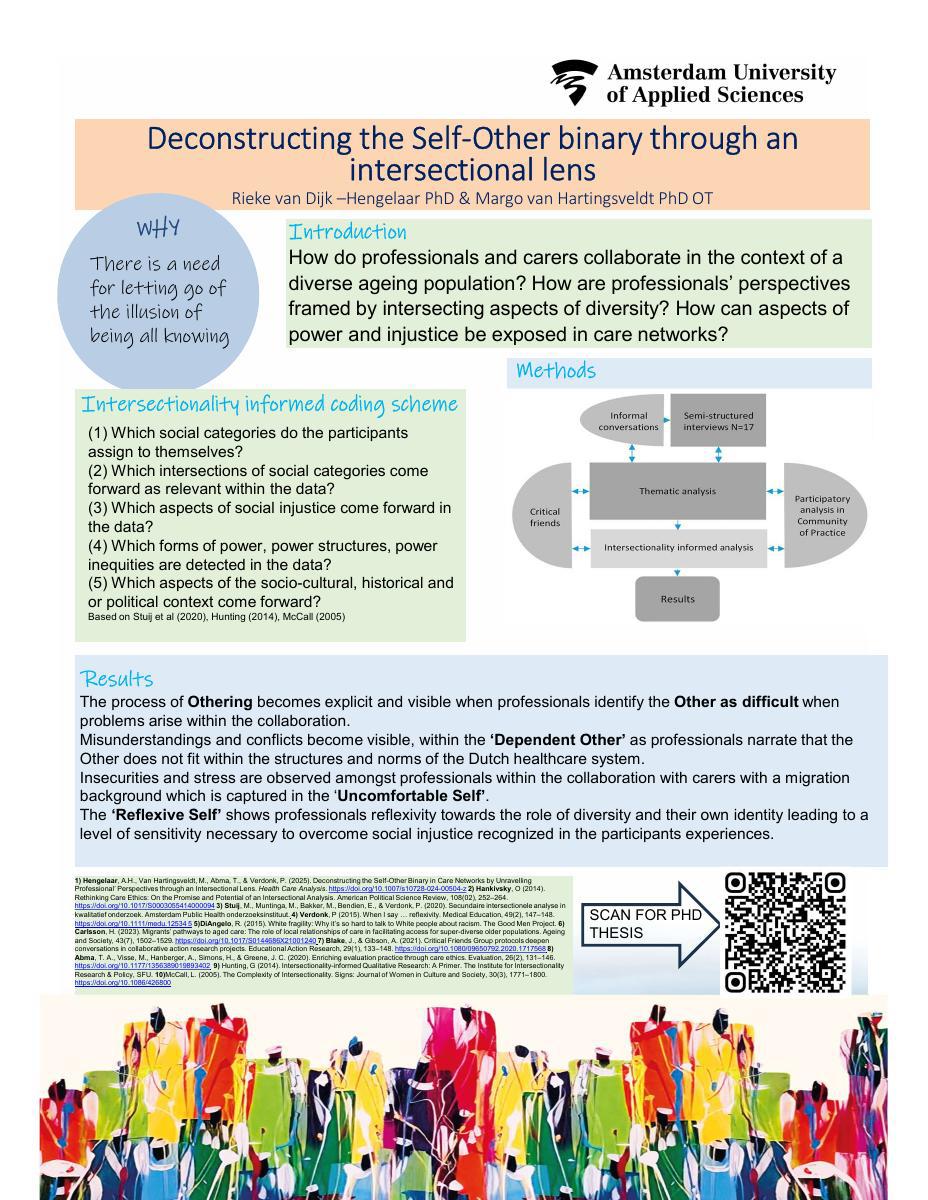
Background and aim: In many western countries informal care is conceived as the answer to the increasing care demand. Little is known how formal and informal caregivers collaborate in the context of a diverse ageing population. The aim of this study was to gain insight in how professionals’ perspectives regarding the collaboration with informal carers with a migration background are framed and shaped by intersecting aspects of diversity.
Methods: We used an intersectionality informed qualitative design with informal conversations (N=12) and semi-structured interviews (N=17) with health professionals working with clients with acquired brain injury. Two critical friends were involved in the analysis which was substantiated by a participatory analysis with a community of practice.
Results: We identified four interrelated themes: (a) ‘The difficult Other’ in which professionals reflected on carers with a migration background causing ‘difficulties’; (b) ‘The dependent Other’ refers to professionals’ realization that ‘difficulties’ are intensified by the context in which care takes place; (c) in ‘The uncomfortable self’ professionals describe how feelings of insecurities evoked by the Other are associated with an inability to act ‘professionally’, and; (d) ‘The reflexive self’ shows how some professionals reflect on their own identities and identify their blind spots in collaboration within a care network.
Conclusion: These themes demonstrate the tensions, biases and power imbalances between informal cargivers and professionals, which may explain some of the existing health disparities perpetuated through care networks.