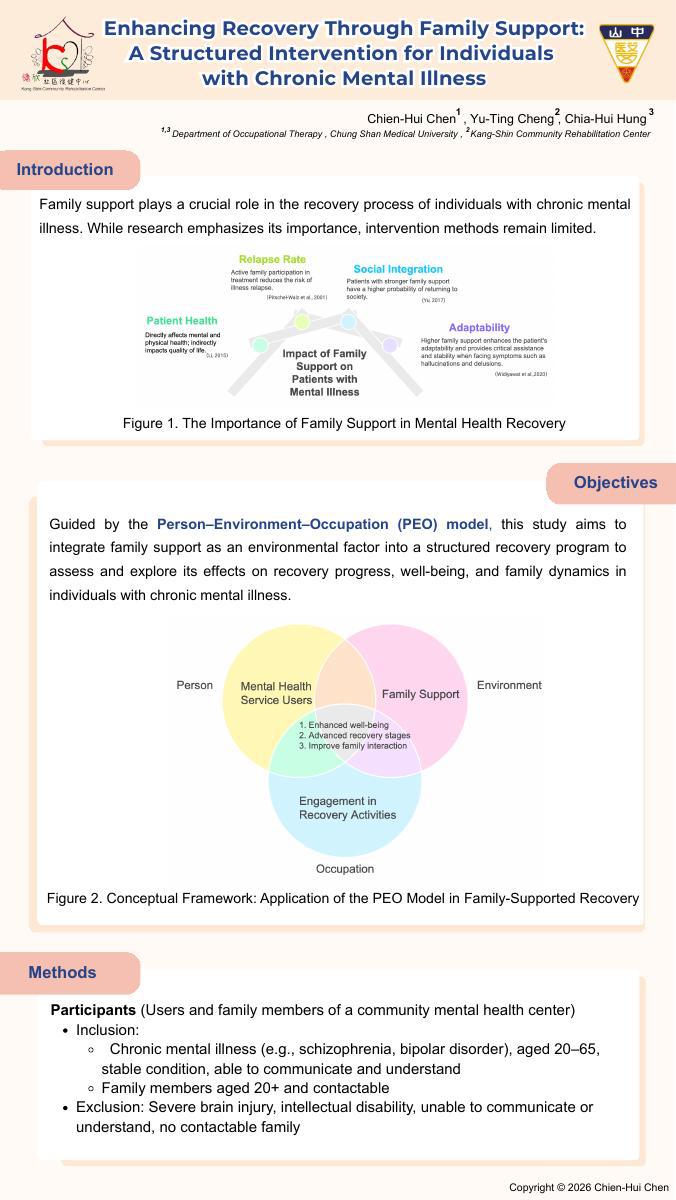
Introduction: Family support plays a crucial role in the recovery process of individuals with chronic mental illness. While research emphasizes its importance, intervention methods remain limited.
Objectives: This study aims to integrate family support into a structured recovery program to assess and explore its effects on recovery progress, well-being, and family dynamics in individuals with chronic mental illness.
Methods: A nine-week intervention, "Happiness Blueprint: Family Support in the Journey of Recovery," was developed based on the recovery framework of Connectedness, Hope and Optimism, Identity, Meaning in Life, and Empowerment (CHIME), integrating Illness Management and Recovery (IMR) and Pathways to Recovery (PTR) principles. Ten community-based chronic mental health participants engaged in weekly sessions, with pre-and post-intervention assessments using the Recovery Assessment Scale -Domains and Stages (RAS-DS), Family Support Scale, and Chinese Happiness Inventory (CHI). Qualitative data were collected through semi-structured interviews and analyzed using content analysis. Wilcoxon sign-rank test was used for statistical comparisons.
Results: Quantitative results showed significant improvements in recovery (p = 0.012), particularly in Looking Forward (p = 0.027), Mastering My Illness(p = 0.028), and Connecting and Belonging(p = 0.011) domains, as well as well-being (p = 0.040), especially optimism (p = 0.041) and positive emotions (p = 0.040). Though family support scores were not statistically significant (p = 0.293), qualitative data revealed improved family communication and understanding.
Conclusion: This study highlights the potential of structured family-supported interventions in promoting recovery and well-being. It underscores the role of occupational therapy in integrating family support into mental health interventions to enhance recovery and well-being.
