
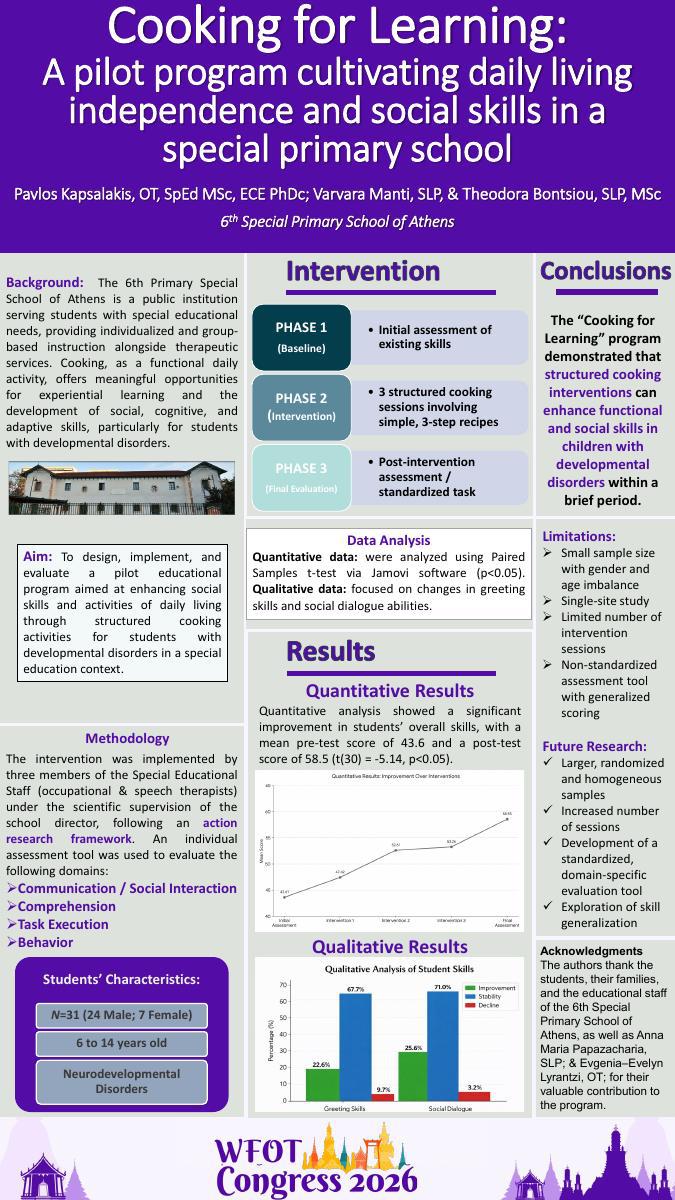
Introduction / Rationale: Cooking is a fundamental daily activity that provides opportunities for experiential learning. It allows students to develop cognitive, social, behavioral, and motor skills essential for independent participation in school and personal life. This study explores how a structured cooking program can enhance autonomy and inclusion for students with developmental disorders.
Objectives: The primary objective is to assess the impact of a therapeutic cooking program on the development of essential life skills among students aged 6–13 attending a Special Primary School. Secondary objectives include evaluating social participation, communication improvements, and adaptive skill development.
Methods / Approach: The program, implemented by an occupational therapist and a speech therapist, adopts an action research methodology with continuous reflection and feedback. Quantitative assessments involve structured questionnaires, while qualitative data is collected through structured observations and semi-structured interviews with parents. The intervention is designed to foster self-efficacy, skill acquisition, and environmental adaptation.
Results / Practice Implications: Preliminary findings suggest notable improvements in students’ engagement, independence, and adaptive responses. Parents report increased participation in daily activities, while educators observe better social interactions and communication. These findings support the integration of cooking as a therapeutic tool in special education settings.
Conclusion / Contribution to the occupational therapy profession: This pilot program highlights the value of cooking interventions in occupational therapy, emphasizing their role in skill-building, social inclusion, and independence. It reinforces the need for interdisciplinary collaboration and action research to refine therapeutic strategies for children with developmental disorders. The findings advocate for the expansion of similar programs to enhance autonomy and meaningful participation in broader social contexts.