
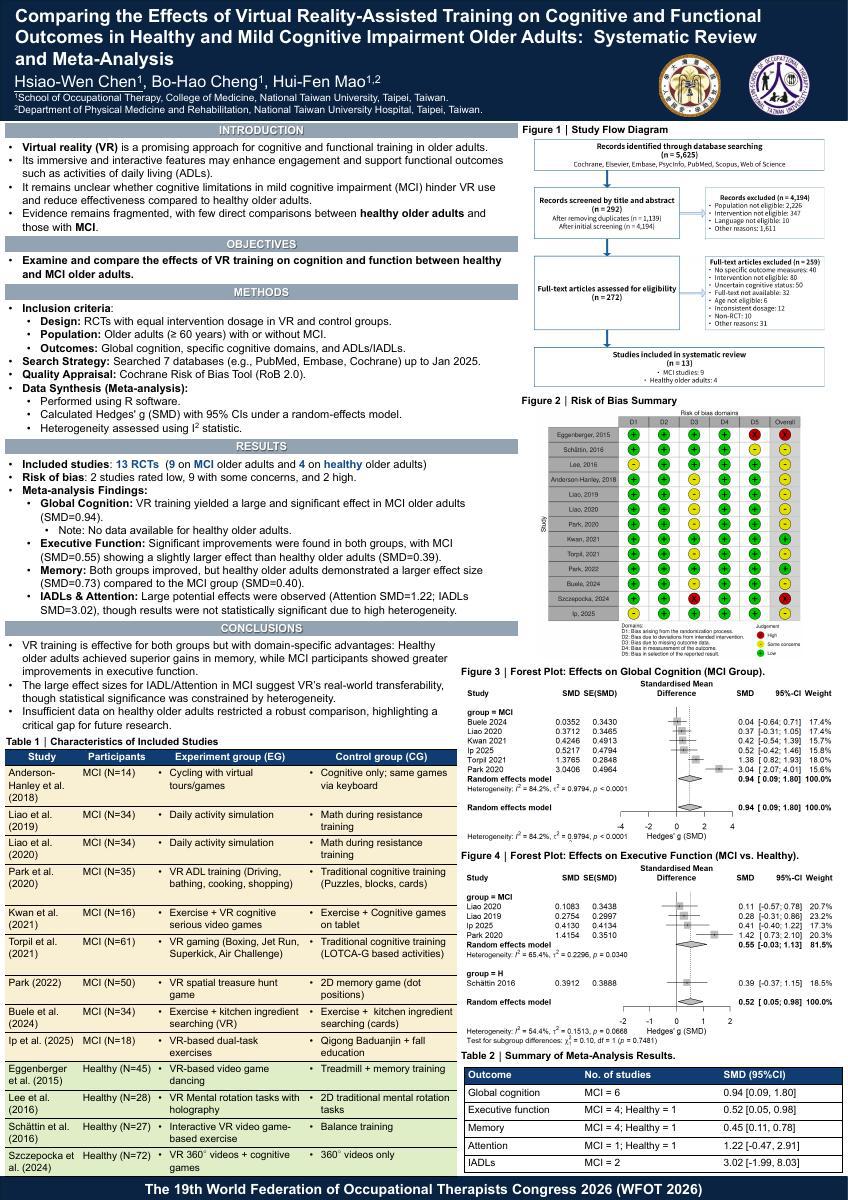
Introduction: Virtual reality (VR) training has shown promise in enhancing cognitive and functional abilities, but research is limited by small sample sizes, diverse study designs, and insufficient comparisons between healthy older adults and those with mild cognitive impairment (MCI).
Objective: This systematic review examines and compares the effects of VR training on cognition and function in these two populations, aiming to guide future research and applications.
Methods: We searched seven databases (Cochrane, Elsevier, Embase, PsycInfo, PubMed, Scopus, Web of Science) for publicly available studies up to January 2025. Two authors independently screened studies, resolving discrepancies with a senior researcher. Eligible randomized controlled trials (RCTs) included interventions explicitly targeting cognition or daily function, with equal intervention doses in experimental and control groups.
Results: Thirteen RCTs were included, with nine focusing on MCI and four on healthy older adults. Risk of bias assessment using RoB 2.0 indicated some concerns of bias in most studies. VR training positively impacted global cognition, activities of daily living (ADL), and emotional regulation in MCI. Research on healthy older adults was limited, with no studies addressing ADL or emotional outcomes. Effects on executive function, memory, attention, processing speed, and cognitive flexibility were comparable between healthy and MCI groups, with mixed findings—some studies reported significant improvements, while others found no effect.
Conclusion: VR training shows potential for enhancing cognition and function in older adults. However, more rigorous research is needed to confirm its clinical value and optimize training models for both healthy and MCI populations.