
Introduction/Rationale: Assessment tools can become outdated and obsolete when new revised versions are published and made widely available to clinicians. Practitioners must consider how to incorporate current versions of assessments while striving to integrate cultural awareness, sensitivity, and competency throughout the evaluation process.
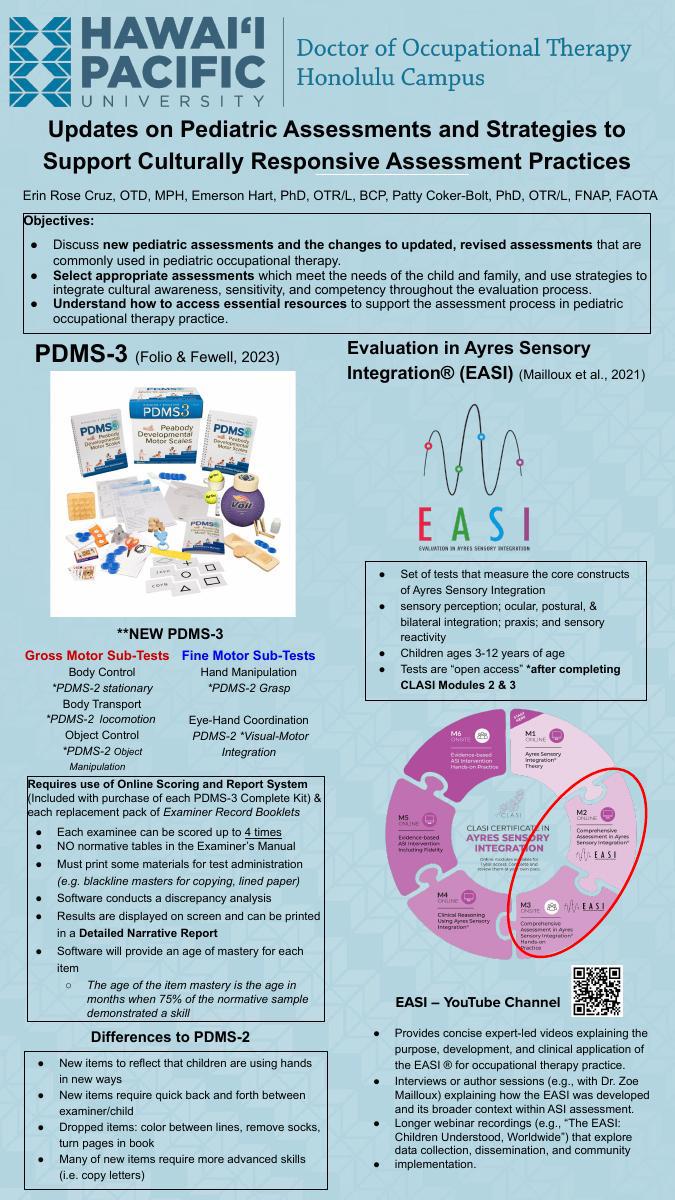
Objective: To provide information about new version of standardized pediatric assessments including the Peabody Developmental Motor Scales-3rd Ed (PDMS-3), the Bruininks-Oseretsky Test of Motor Proficiency-3 (BOT-3), the Structured Observations of Sensory Integration – Motor (SOSI-M) and the Evaluation in Ayres Sensory Integration® (EASI) and discuss strategies to support culturally responsive evaluation practices.
Methods/Approach: Detailed information will be provided about new versions of the PDMS-3 and the BOT-3 including new items, scoring procedures, web-based trainings, provider resources. Participants will learn new assessments to evaluate sensory processing including activities in the new SOSI-M and the EASI and also learn how to evaluate pediatric unilateral neglect.
Results/Practice Implications: Practitioners must understand new online scoring and reporting systems for PDMS-3 and BOT-3 assessments. Practitioners must learn also how to navigate current challenges and opportunities to support culturally responsive practices while administering activities within any standardized assessment used in a comprehensive evaluation. Assessments must be relevant to the child and the family’s needs, context, and environment. The evaluation process should accurately report the child’s capabilities (strengths) and challenges (deficits and weaknesses) to support a comprehensive plan of care.
Conclusion / Significance to the Occupational Therapy Profession: The type and focus of pediatric OT evaluation may differ depending on the practice setting and practitioner preferences; however, all evaluations should assess the culturally-relevant and complex multifaceted needs of each child to promote overall health, well-being, and occupational justice.