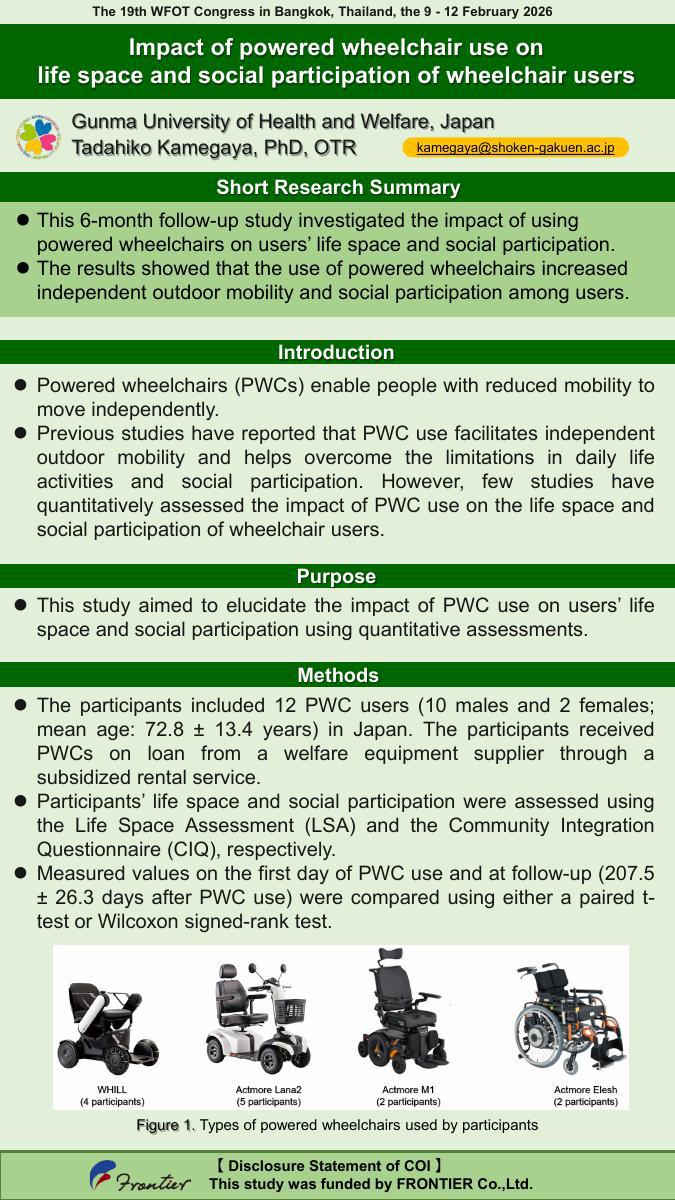
Introduction: Powered wheelchairs enable people with reduced mobility to move independently. The use of powered wheelchairs has been reported to enable wheelchair users’ independent outdoor mobility and help overcome limitations in daily life activities and social participation. However, few studies have quantitatively assessed the impact of powered wheelchair use on the life space and social participation of wheelchair users.
Objective: To elucidate the impact of powered wheelchair use on the user’s life space and social participation based on quantitative assessments.
Methods: The study participants were 12 powered wheelchair users (72.8 ± 13.4 years old, 10 males and 2 females) in Japan. The participants’ life space and social participation were assessed using the Life Space Assessment (LSA) and the Community Integration Questionnaire (CIQ), respectively. Measured values on the first day of powered wheelchair use and 207.5 ± 26.3 days after the start of use were compared using either a paired t-test or Wilcoxon signed rank sum test.
Results: Total LSA scores increased significantly after use (p < 0.01). Scores on the CIQ subscales “social interaction” (instrumental activities of daily living and leisure activities) and “integration into productive activities” (employment and volunteering) also increased significantly after use (p < 0.05).
Conclusion: The increase in LSA scores suggests that powered wheelchair use expanded the participant’s life space and range of activities. The increase in the CIQ subscale scores suggests that powered wheelchair use promoted the participants’ social interaction and improved their integration into productive activities.
