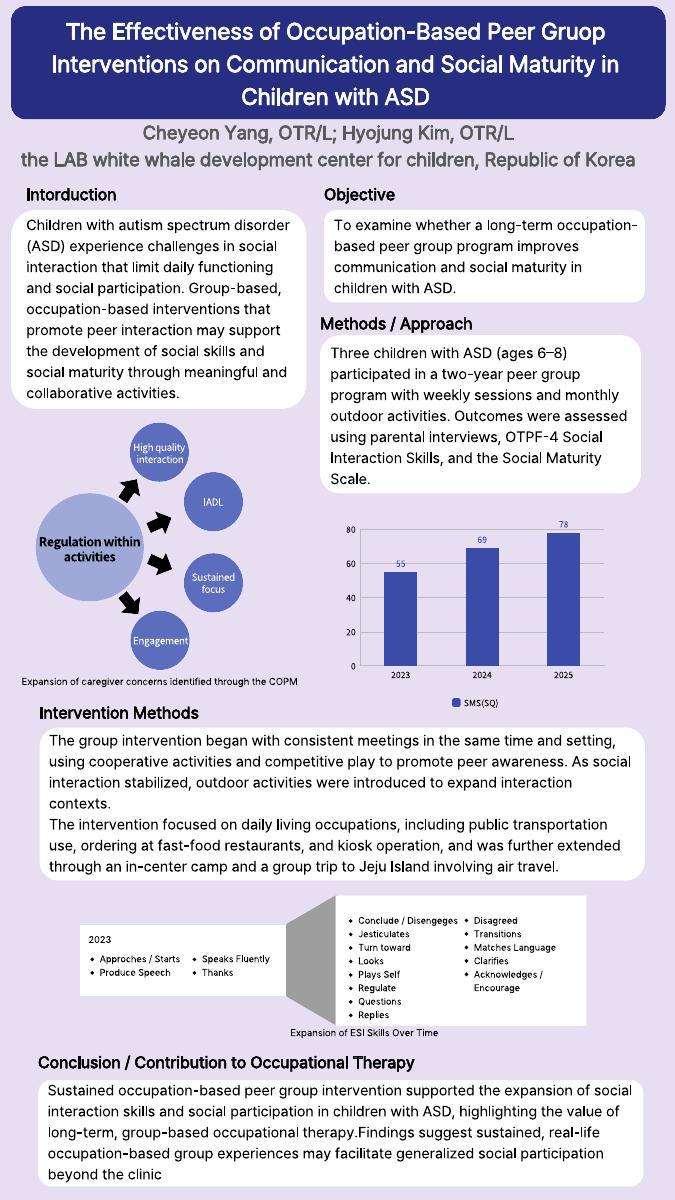
Introduction / Rationale: Children with Autism Spectrum Disorder (ASD) exhibit persistent deficits in social communication and interaction, affecting their daily functioning and participation. Peer group-based interventions are recognized as effective in enhancing social engagement and relational skills. Occupation-based interventions provide structured, meaningful activities that facilitate functional skill acquisition and generalization within real-life contexts. Collaborative peer interactions further support social maturity and adaptive behavior development.
Objectives: This study examines the effectiveness of long-term occupation-based peer group interventions in improving communication skills and social maturity in children with ASD.
Methods / Approach: A two-year occupation-based intervention was conducted with three elementary school children (ages 6–8) diagnosed with ASD. Participants engaged in structured peer group sessions (60 minutes, three times per month) and monthly outdoor activities. Intervention outcomes were assessed using pre- and post-intervention parental interviews, OTPF-4 Social Interaction Skills, and the Social Maturity Scale.
Results / Practice Implications: Findings indicate that prolonged engagement in peer group interventions significantly improved social relationships, communication skills, and adaptability in new environments. Structured peer interactions enhanced spontaneous social participation and relational development.
Conclusion / Contribution to the occupational therapy profession: This study highlights the therapeutic value of sustained occupation-based peer interventions in fostering social competence and participation in children with ASD. The results emphasize the need for long-term group-based occupational therapy programs, providing empirical support for peer-based social participation interventions.
