
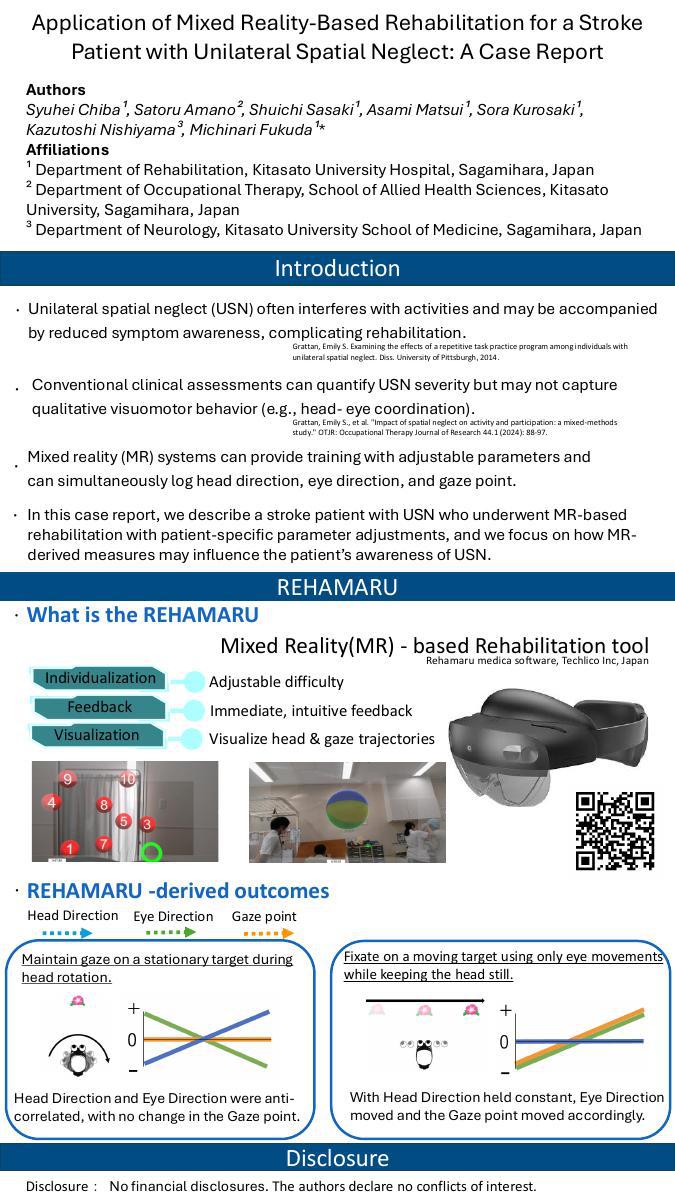
Introduction: Unilateral spatial neglect (USN) affects 30–70 % of stroke patients, impairing daily activities. USN is also linked to decreased awareness of the symptoms, making the training challenging (Grattan et al., 2017). Conventional assessments, such as the Behavioral Inattention Test (BIT) and the Catherine Bergego Scale (CBS), lack qualitative measures like gaze and head movements. Additionally, conventional interventions rely on therapists, limiting individualized training. Mixed Reality (MR) technology enables objective assessment of gaze and head movement, providing personalized feedback. This study applied MR-based rehabilitation for assessment and training in a USN patient.
Objectives: To evaluate whether MR-based assessment and training provide objective feedback and support awareness improvement in USN.
Methods: A woman in her 60s with right (hypertensive) putaminal hemorrhage underwent endoscopic hematoma evacuation. On day 5 post-stroke, initial assessment showed BIT: 20/54, line bisection: 2/9, CBS (self-reported): 2, CBS (clinician-rated): 23, confirming USN. MR assessment revealed rightward gaze bias and left-side neglect. Training using MR was customized according to her USN, providing real-time feedback to improve awareness of the symptoms.
Results: On day 27, BIT improved to 48/54, line bisection to 7/9, CBS (self-reported): 3, CBS (clinician-rated): 6. The CBS gap narrowed, suggesting increased awareness. MR assessment showed reduced gaze bias and improved left-field exploration.
Conclusion: MR-based rehabilitation provided objective feedback and individualized training, potentially enhancing awareness. However, spontaneous recovery (Ringman et al., 2004) complicates effect isolation. Further research is needed to clarify MR’s role in USN rehabilitation.