
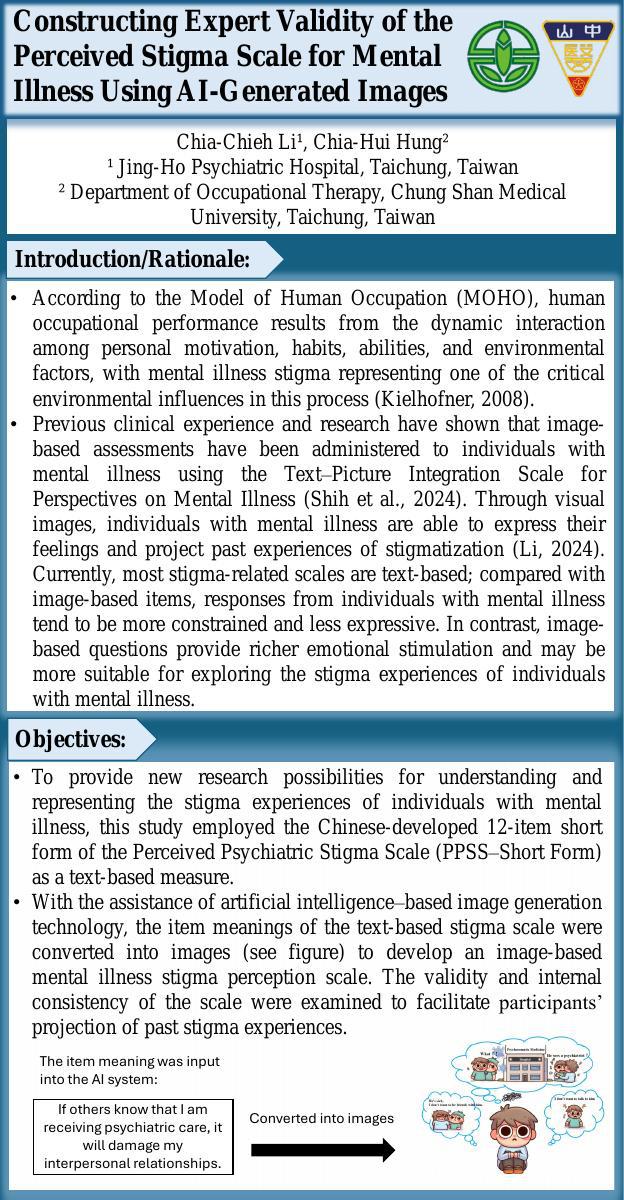
Introduction / Rationale: In past clinical experiences, researchers have found that patients with mental illnesses can express their feelings and project past experiences of stigma through images in questionnaires. Currently, most stigma scales are text-based, and the responses from mental illness patients tend to be more limited and closed compared to image-based questions. Image-based questions can provide patients with more emotional stimulation and are suitable for exploring the stigma experienced by patients with mental illnesses.
Objectives: This study aims to transform text-based stigma scales into image-based mental illness stigma perception scales using AI image generation and establish their validity.
Methods / Approach: Eleven experts in the mental health care field participated, with inclusion criteria being at least 10 years of experience in psychiatry and current involvement with mental illness patients. The experts included psychiatrists, psychiatric nurses, occupational therapists, and community rehabilitation center directors. Text-based questions were converted into images using AI systems. The image-based mental illness stigma perception scale consisted of 13 questions. Experts evaluated each image for satisfaction and relevance using a five-point Likert scale and provided suggestions for modification.
Descriptive statistics were used to integrate and calculate expert evaluations, including item content validity (I-CVI) and overall scale validity (S-CVI).
Results / Practice Implications: The I-CVI for each item ranged from 0.7 to 1.1, with an overall S-CVI of 0.97. Expert feedback suggested modifications to address gender roles, image backgrounds, and character expressions.
Conclusion / Contribution to the occupational therapy profession: The overall research results show that the image-based scale has good expert validity and can be used as a research tool to explore stigma in patients with mental illnesses.