
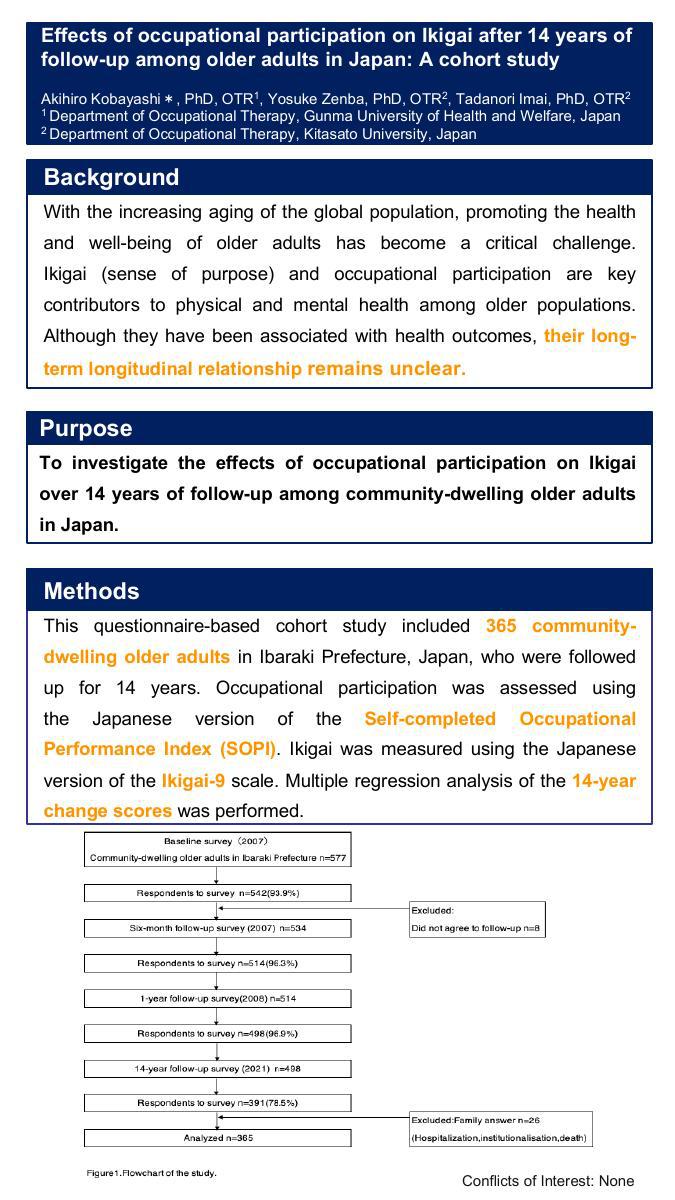
Introduction/Rationale: As populations age, promoting health, well-being, and quality of life among older adults is increasingly important. Ikigaiand occupational participation are key factors supporting physical and mental health in these adults. This study examined the long-term effects of occupational participation on the Ikigai of older adults in a Japanese community over 14 years.
Methods: A questionnaire-based cohort study was conducted, including 498 community-dwelling older adults in Ibaraki Prefecture, Japan, who participated in all follow-up surveys 14 years after the initial survey was conducted. Of these, the data for 365 adults were analyzed. Occupational participation was measured using the Self-completed Occupational Performance Index (SOPI), whereas Ikigai was assessed using the Ikigai-9 scale. For data analysis, multiple regression was performed.
Results: The 14-year change in the SOPI total score had a statistically significant positive effect (p <0.001) on the 14-year change in the Ikigai-9 total score (β =0.415) and its three subscales (β =0.405,0.338, and 0.248). Analyzing the 14-year change in the three SOPI subscales as independent variables revealed positive effects on productivity (β =0.182, p <0.01) and self-care (β =0.337, p <0.001). Similarly, all analyses using the Ikigai-9 subscales as dependent variables showed positive effects on self-care (β =0.285,0.270,0.255; p <0.001).
Conclusion: Occupational participation and Ikigai remained associated over a 14-year period, with the former positively influencing life satisfaction.