
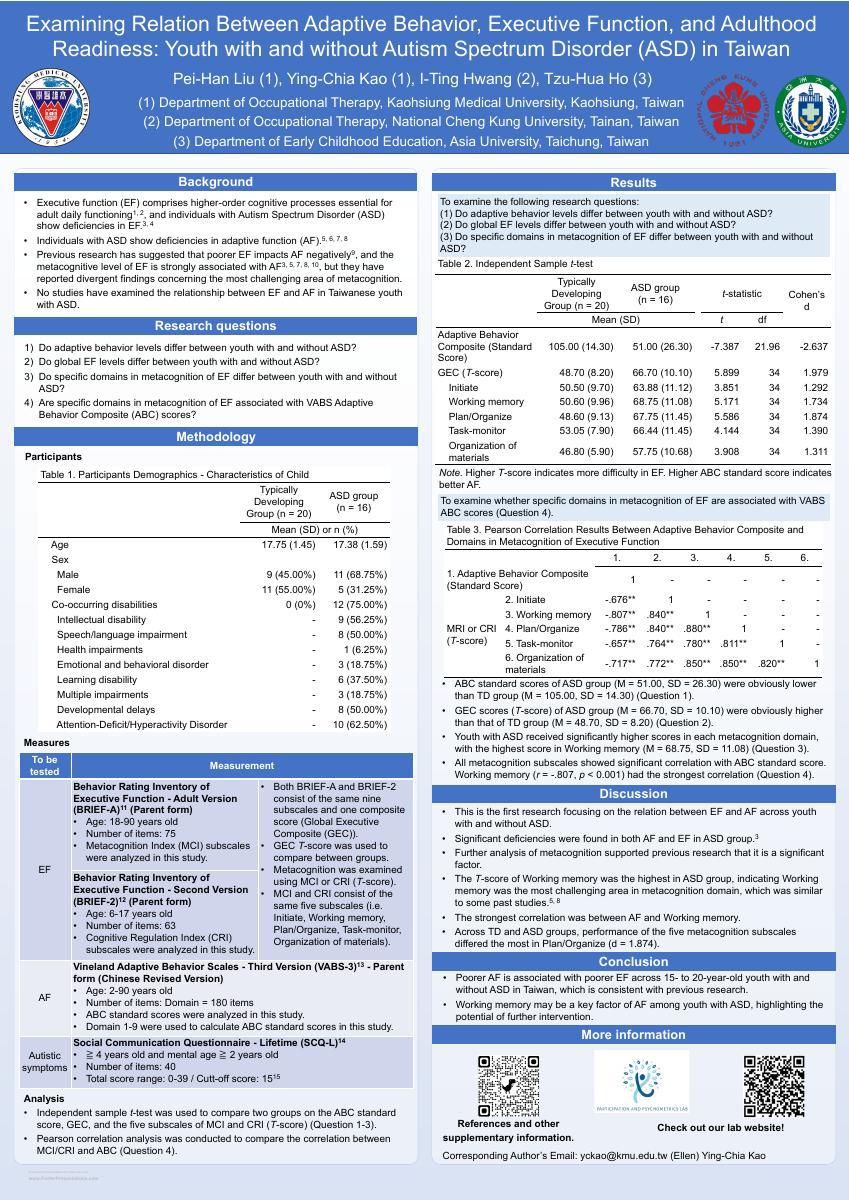
Introduction: Executive function (EF) is defined as a series of higher-order cognitive functions essential for daily life in adulthood. Adaptive behavior reflects an individual's preparedness to enter adulthood. Previous research on EF in youth with autism spectrum disorder (ASD) has yielded mixed findings, and no studies have examined the relationship between EF and adaptive behavior in Taiwanese youth with ASD.
Objective: This study examines the relationship between EF and adaptive behavior in youth with and without ASD in Taiwan.
Method: A cross-sectional study was conducted with parents of youth aged 15–20 years with and without ASD. Parents completed the Vineland Adaptive Behavior Scales–Third Edition (Vineland-3) and either the Behavior Rating Inventory of Executive Function–Second Edition (BRIEF-2) for youth aged 15–17 years or the Behavior Rating Inventory of Executive Function–Adult Version (BRIEF-A) for youth aged 18–20 years. The Social Communication Questionnaire (SCQ) was used for ASD screening. Descriptive statistics, Pearson correlations, and independent samples t-tests were conducted for data analysis.
Results: The study included 19 parents of youth without ASD and 9 parents of youth with ASD. Significant group differences were found in EF (Global Executive Composite T-score) and adaptive behavior (Adaptive Behavior Composite, Communication, Daily Living Skills, and Socialization standard scores). Significant moderate correlations were observed between EF and adaptive behavior.
Conclusion: Findings suggest that youth with stronger EF skills tend to exhibit better adaptive behavior. These results may inform interventions aimed at enhancing EF to support adaptive functioning in youth with ASD.