
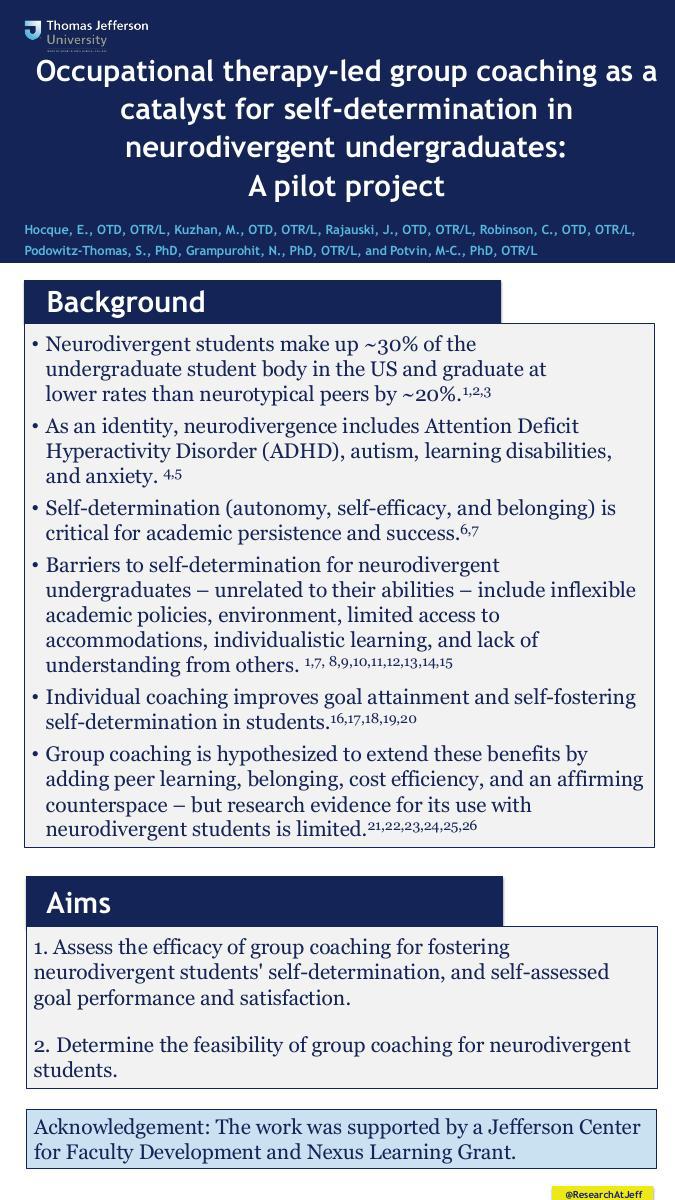
Introduction / Rationale: Neurodivergent undergraduate students face self-determination challenges (e.g., self-efficacy and belonging) known to negatively impact occupational performance in academics and, ultimately, success in higher education. Occupational therapy-led one-on-one coaching supports self-efficacy. Belonging is thought to be best addressed through group coaching.
Objective: To determine the efficacy and feasibility of group coaching for fostering self-determination in neurodivergent undergraduates.
Methods / Approach: A one-group pretest-posttest pilot study with 9 neurodivergent students was conducted. Participants attended 10 group coaching sessions facilitated by an occupational therapist trained in coaching, with pre and post-data collected through the Canadian Occupational Performance Measure (COPM), Sense of Belonging Scale (SoB), and post-test feasibility measures (i.e., acceptability, feasibility, and appropriateness).
Results / Practice Implications: Significant improvement in participants' self-efficacy [COPM Performance p<0.001; COPM Satisfaction p<0.001] was found, with COPM scores showing clinically meaningful change (≥2). Change in belonging were more modest but in a positive direction [SoB Perceived Peer Support MD=0.31, SD=0.92, Perceived Classroom Comfort MD=0.42, SD=0.67, Perceived Isolation MD=-0.14, SD=0.47, Perceived Faculty Support MD=0.33, SD=0.61]. Group coaching was deemed feasible with means scores (acceptability: m=4.72, SD=0.36; appropriateness: m=4.28, SD=0.61; and feasibility: m=4.64, SD=0.38) above the pre-determined benchmark score of 3.
Conclusion / Contribution to the occupational therapy profession: This study suggests that OT-led group coaching is an efficacious and feasible approach to support neurodivergent undergraduates’ self-determination and in turn their academic success. This innovative study is the first investigation of group coaching in OT.