
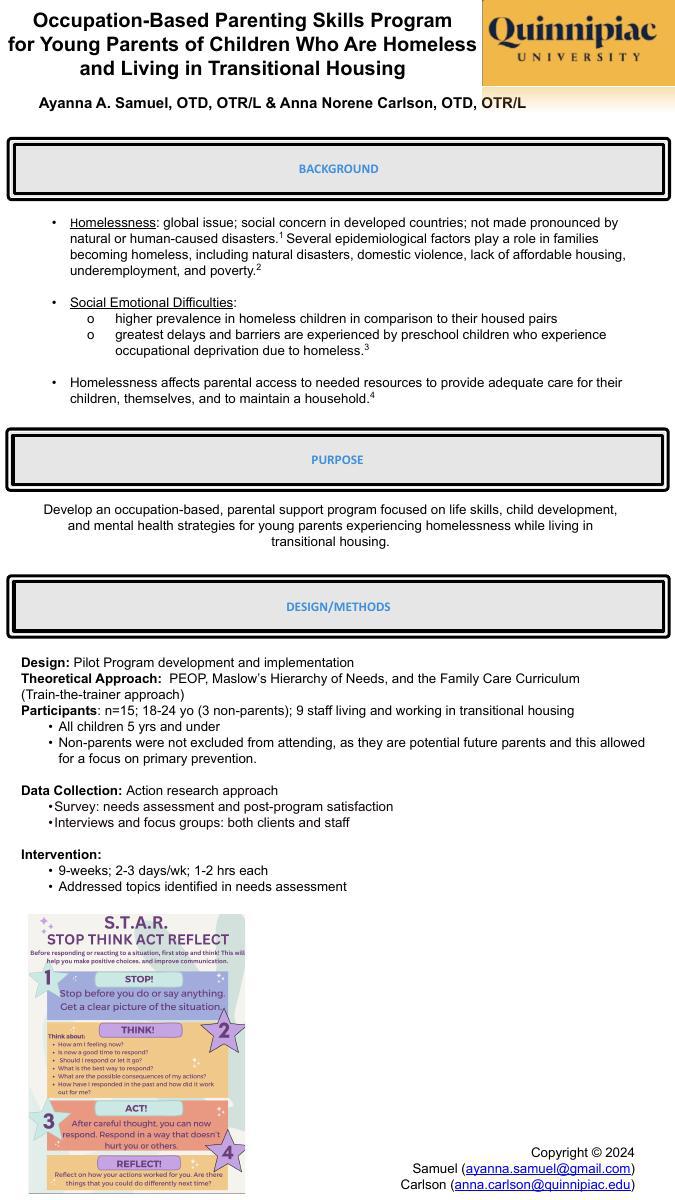
Introduction / Rationale: Homelessness is a global issue that is not exclusive to any one country or made pronounced by natural or human-caused disasters. Social emotional problems are prevalent among homeless children at a higher rate, compared to their housed pairs. The greatest delays and barriers are experienced by very young children who lack the services that school-aged children receive. Homelessness affects parental access to the resources needed to provide adequate care for their children, themselves, and to maintain a household.
Objectives: The program objective was to address the parenting needs of young families experiencing homelessness living in transitional housing and identifying OT interventions to enhance their parenting skills.
Methods / Approach: A pilot program was developed and implemented using an action research approach.The Parent Sense of Competence Scale and focus groups were used to gather quantitative and qualitative outcomes of the program.
Results / Practice Implications: There was 100% satisfaction among clients and staff. The results can inform the benefit of establishing a sustainable OT presence in community-based programs to address mental health, self-care, leisure, and social participation for parents and children. In addition OTPs can address inequities that disrupt occupational participation, by using an occupation-based parenting skills program.
Conclusion / Significance to the Occupational Therapy Profession: The knowledge and experience of OTs in early childhood development, sensory modulation, and attachment, positions them to provide support to those experiencing trauma. For this reason, a 9-week educational occupation-based parenting program was developed which included topics focused on parental mental health, child development, and parent-child bonding.