
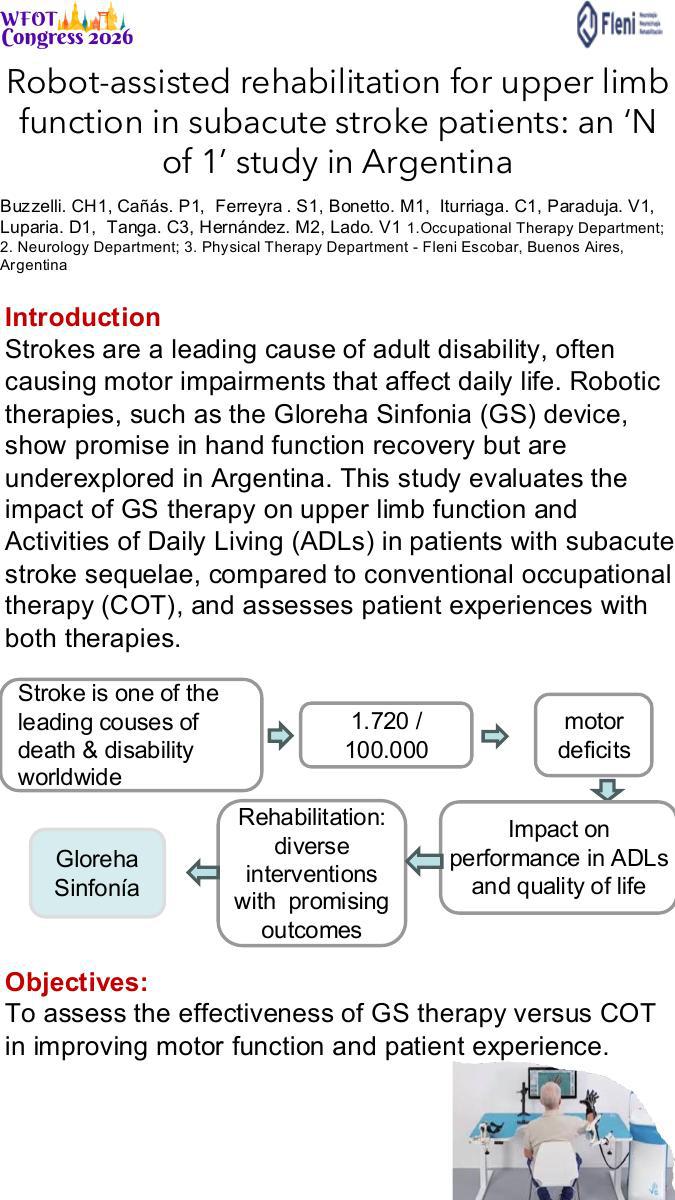
Introduction / Rationale: Strokes are a leading cause of adult disability, often causing motor impairments that affect daily life. Robotic therapies, such as the Gloreha Sinfonia (GS) device, show promise in hand function recovery but are underexplored in Argentina. This study evaluates the impact of GS therapy on upper limb function and Activities of Daily Living (ADLs) in patients with subacute stroke sequelae, compared to conventional occupational therapy (COT), and assesses patient experiences with both therapies.
Objectives: To assess the effectiveness of GS therapy versus COT in improving motor function and patient experience.
Methods / Approach: This prospective longitudinal study used an "N of 1" reversing design (A-B-A) with 15 sessions per phase: phase A with COT and phase B with GS therapy. Patients with subacute stroke and impaired arm movement were included. Assessments included FIM, UL-MAS, Fugl-Meyer Scale, Ashworth Scale, and Intrinsic Motivation Inventory (IMI).
Results / Practice Implications: Seven patients (mean age 56) participated. Motor function improved after COT: FIM-Motor Δ+9.57 (p=0.0001), Fugl-Meyer Δ+11.14 (p=0.01), and UL-MAS Δ+1.57 (p=0.02). Spasticity increased slightly (Δ+0.57, p=0.0139). No significant differences were found between GS and COT phases, and the IMI showed similar patient acceptance.
Conclusion / Contribution to the Occupational Therapy Profession: The study showed motor function improvements, but it is unclear whether these results are due to cumulative therapy effects or the robotic device, as no significant differences were found. Larger studies are needed to clarify. The study highlights the importance of exploring robotic devices in occupational therapy, as they could complement or enhance traditional rehabilitation methods.