
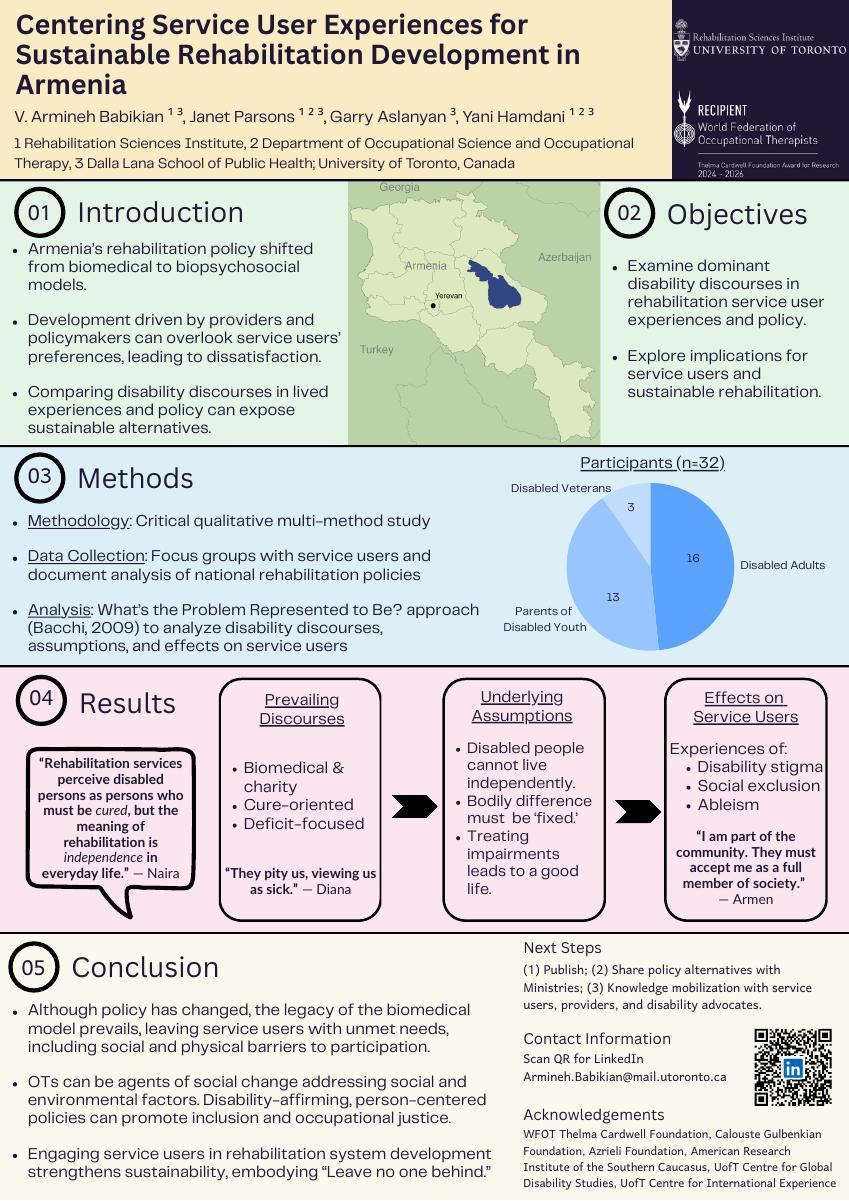
Introduction: Prevailing disability conceptualizations in Armenian rehabilitation development are informed by the ICF biopsychosocial model, critiqued for minimizing the impact of social barriers to participation. Local disability advocates argue for a human rights model in which disability is part of human diversity. Centering service users' needs can lead to more relevant services that support human rights and inclusion.
Objectives: This research aimed to (1) critically examine disability conceptualizations within influential policies and lived experience perspectives of service users, and (2) explore implications for service users and sustainable rehabilitation development.
Methods: Guided by a critical social science perspective and Bacchi’s (2016) “What’s the Problem Represented to be?” approach, a multimethod qualitative design was used, involving analysis of policy documents relevant to Armenian rehabilitation development and focus group discussions with service users.
Results: Despite acknowledgement of social and environmental influences on disability, current rehabilitation policies emphasize impairments and do little to address social barriers on community participation. This can be beneficial for some service users (e.g., soldiers, acute injuries) but can have unintended consequences for those with lifelong disability, perpetuating their social exclusion. Rethinking disability from an occupational justice lens and centering service user perspectives can improve equitable access to community participation and quality of life.
Conclusion: As key Armenian rehabilitation service users, it is important to collaborate with people with disabilities to develop a person-centered system that embodies the UN sustainable development principle “Leave no one behind.” Alternative approaches include rights-based rehabilitation, disability-affirming care, and positioning occupational therapists as social change agents to create equitable and inclusive services.