
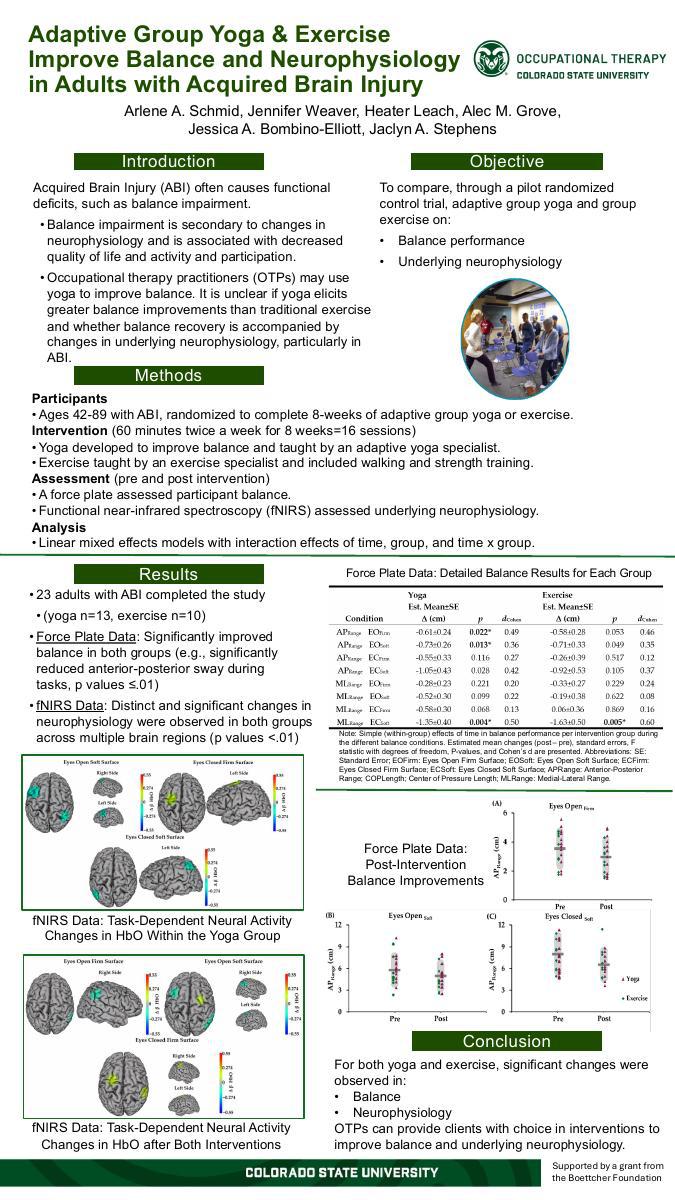
Inroduction: Acquire brain injury (ABI) often causes functional deficits, like balance impairment, secondary to changes in neurophysiology. Balance impairment is associated with decreased quality of life and activity and participation. Occupational therapy practitioners (OTP) may use yoga to improve balance. It is unclear if yoga elicits greater balance improvements than traditional exercise and whether balance recovery is accompanied by changes in underlying neurophysiology, particularly in ABI.
Objective: To compare adaptive group yoga and group exercise on balance performance and underlying neurophysiology in a pilot randomized control trial.
Methods/Approach: Participants with ABI were randomized to complete either 8-weeks of adaptive group yoga or exercise. Yoga was developed to improve balance and taught by an adaptive yoga specialist. Exercise was taught by an exercise specialist and included walking and strength training. A force plate and functional near-infrared spectroscopy were used simultaneously to assess balance and underlying neurophysiology before and after interventions. Linear mixed effects models were used to evaluate the effect of time, group, and time x group interaction effects.
Results: 23 adults with ABI completed the study (yoga n=13, exercise=10). Participants in both groups had significantly improved balance (e.g., significantly reduced anterior-posterior sway during tasks, p values ≤.01). Distinct and significant changes in neurophysiology were observed in both groups across multiple brain regions (p values <.01)
Conclusion: Both yoga and exercise elicited significant changes in balance and neurophysiology. This is significant for OTPs because they can provide clients with choice in interventions to improve balance and underlying neurophysiology.