
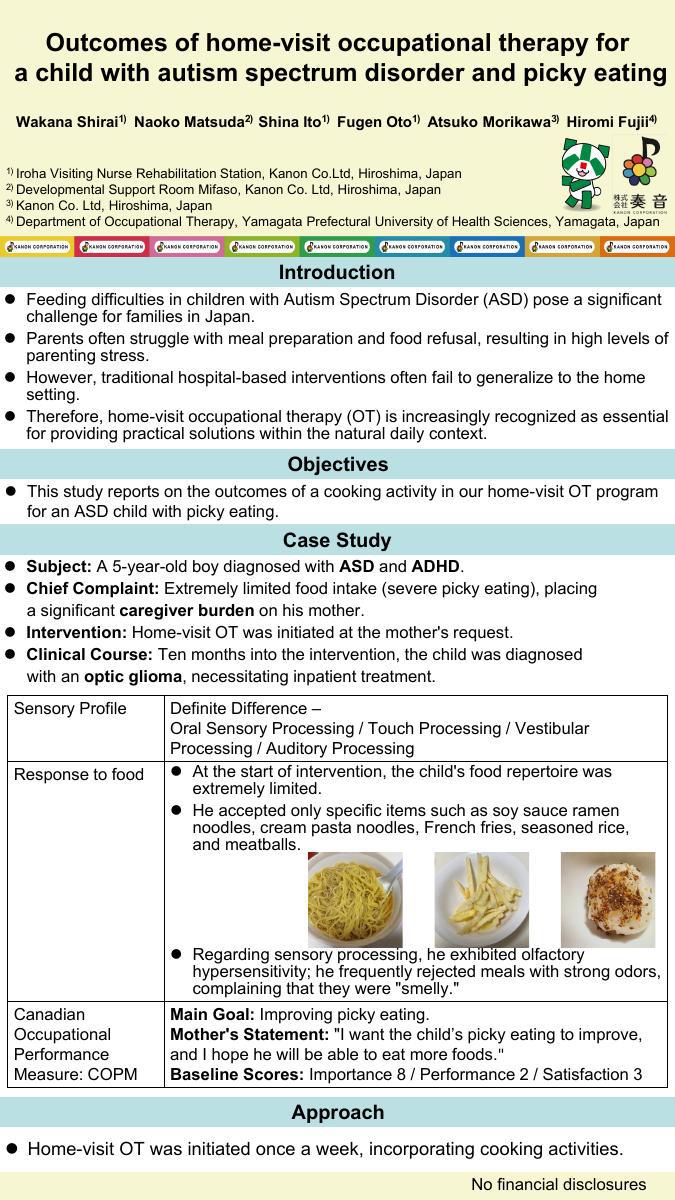
Introduction: A child's picky eating habits have a negative impact on their healthy growth and development. Many of the school-refusing children we treat through our home visit occupational therapy services have picky eating habits.
Objectives: This study examines the outcomes of a cooking activity within a home-visit occupational therapy (OT) program for a child with autism spectrum disorder (ASD) and picky eating habits.
Approach: The case involved a 5-year-old male diagnosed with ASD and attention-deficit/hyperactivity disorder. His food intake was extremely limited, posing a significant burden on his mother. The Canadian Occupational Performance Measure (COPM) scores based on an interview with the mother were as follows: eight for importance, two for performance, and three for satisfaction.
Results: The child’s food aversion was linked to past unpleasant experiences. To introduce new foods, interventions ensured predictable seasoning and cooking methods. Regular information sharing with the child’s development support facility was maintained. As his food variety expanded through cooking activities, his social participation at the child’s development support facility improved. After 6 months, COPM scores improved to 8 in importance, 4 in execution, and 5 in satisfaction.
Conclusion: Understanding the underlying causes of picky eating facilitated the child’s engagement in cooking activities and increased his motivation to try new foods. Collaboration with the child’s development support facility enabled a tailored intervention, improving not only food acceptance but also reducing parental stress. These findings suggest that OT-based cooking activities can enhance dietary habits and support overall developmental progress.