Introduction / Rationale: The number of patients with dementia in Japan is expected to reach 7.4 million by 2030, making dementia care an urgent issue. A high level of physical activity has been associated with reduced brain atrophy and delayed progression of dementia. Additionally, studies have reported that individuals who frequently engage in intellectual activities tend to experience reduced hippocampal atrophy.
Objectives: This study aimed to examine the relationships between age, cohabitation status, engagement in active hobbies, and the degree of hippocampal atrophy in patients diagnosed with mild cognitive impairment (MCI) or Alzheimer's disease (AD).
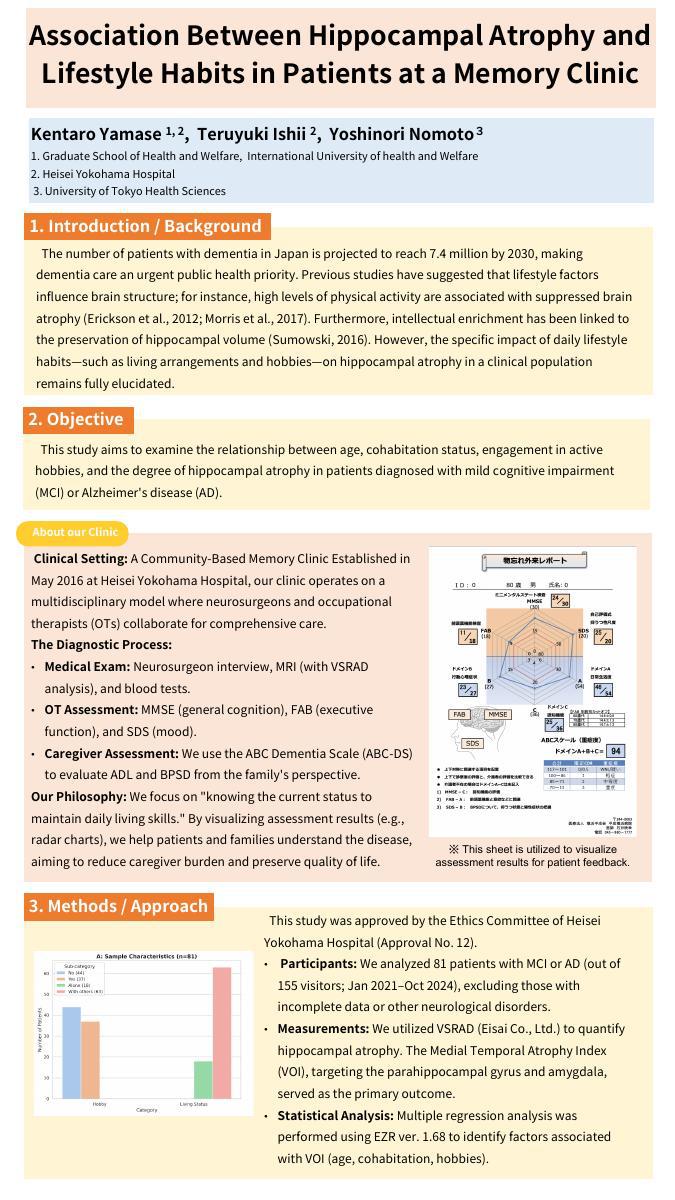
Methods / Approach: Participants included 81 patients diagnosed with mild cognitive impairment(MCI) or Alzheimer's disease(AD) from a total of 155 individuals who visited the memory clinic in Heisei Yokohama Hospital between January 2021 and October 2024. The degree of hippocampal atrophy was assessed using the medial temporal atrophy index (VOI) of the Voxel-Based Specific Regional Analysis System for Alzheimer’s Disease (VSRAD) developed by Eisai Co., Ltd. Multiple regression analysis was performed to examine the relationships between hippocampal atrophy and age, cohabitation status, and having active hobbies.
Results / Practice Implications: Age (β=0.0567, p=0.00549) and having active hobbies (β=-0.6654, p=0.00540) had a significant impact on hippocampal atrophy as measured by medial temporal atrophy index(VOI). In contrast, cohabitation status did not show a significant difference compared to hippocampal atrophy.
Conclusion / Contribution to the occupational therapy profession: Engaging in active hobbies may help mitigate hippocampal atrophy. Occupational therapists can play a crucial role in the prevention of dementia by creating opportunities for social participation and supporting the continuation of meaningful activities tailored to individual needs.
