
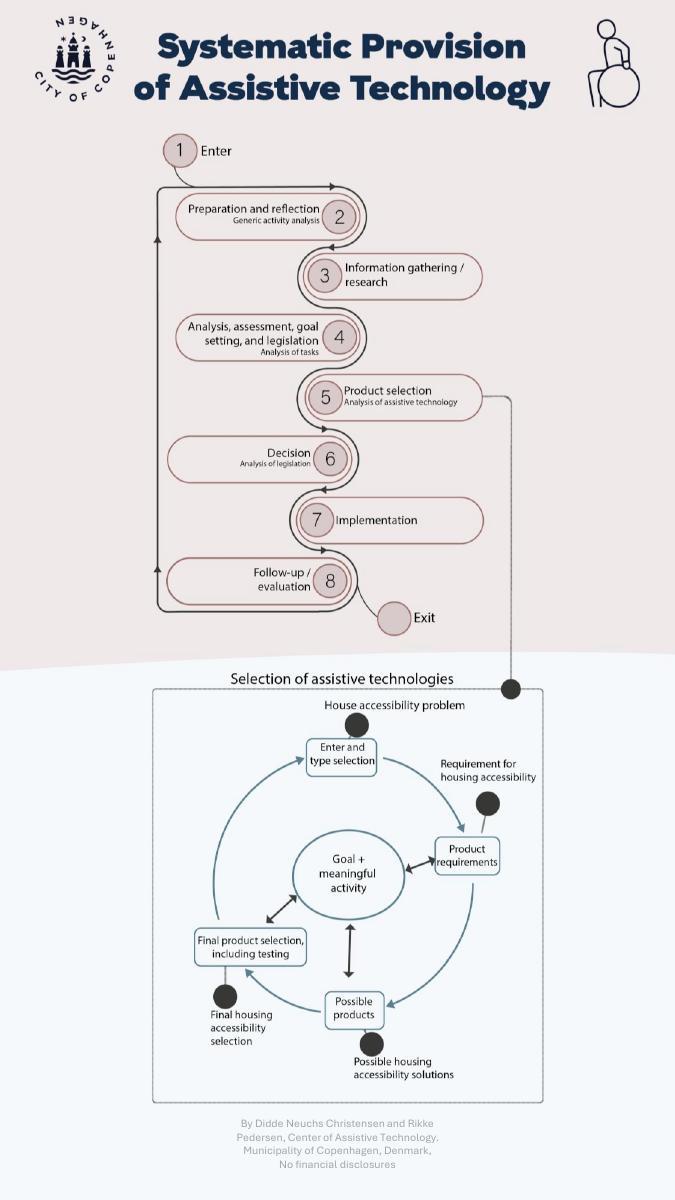
Introduction: Existing occupational therapy process models are generic and hence insufficient to inform and guide a thoroughly provision process of assistive technology. Consequently, there is a risk of choosing a poor assistive technology to the person in question, to work ineffectively or that the quality of the provision process is diverse.
Objectives: To develop a new transactional occupation-centered process model of relevance to clinical occupational therapists providing assistive technology.
Approach: First, several workshop-based iterations with five experienced occupational therapists were conducted serving to map out an ideal process to identify the most optimal assistive technology to the client in question.
Next, the authors condensed and categorized the content into a stepwise process model, which was discussed with the five occupational therapists for further elaboration until consensus was reached. Finally, the process model was likewise discussed and elaborated in another group of occupational therapists.
Results: The new process model consists of eight steps and four analyses: a generic activity analysis, a task analysis, an assistive technology analysis and a legislative analysis, of which the latter two are new. The process model reflects the connections between these analyses.
Conclusion/significance to occupational therapy profession: The provision of assistive technology may also involve housing adaptation and is a complex working process. With this working process model at hand, it will be possible to support, guide and qualify a thorough assistive technology provision process for the benefit of the user, provision practice and society at large.