
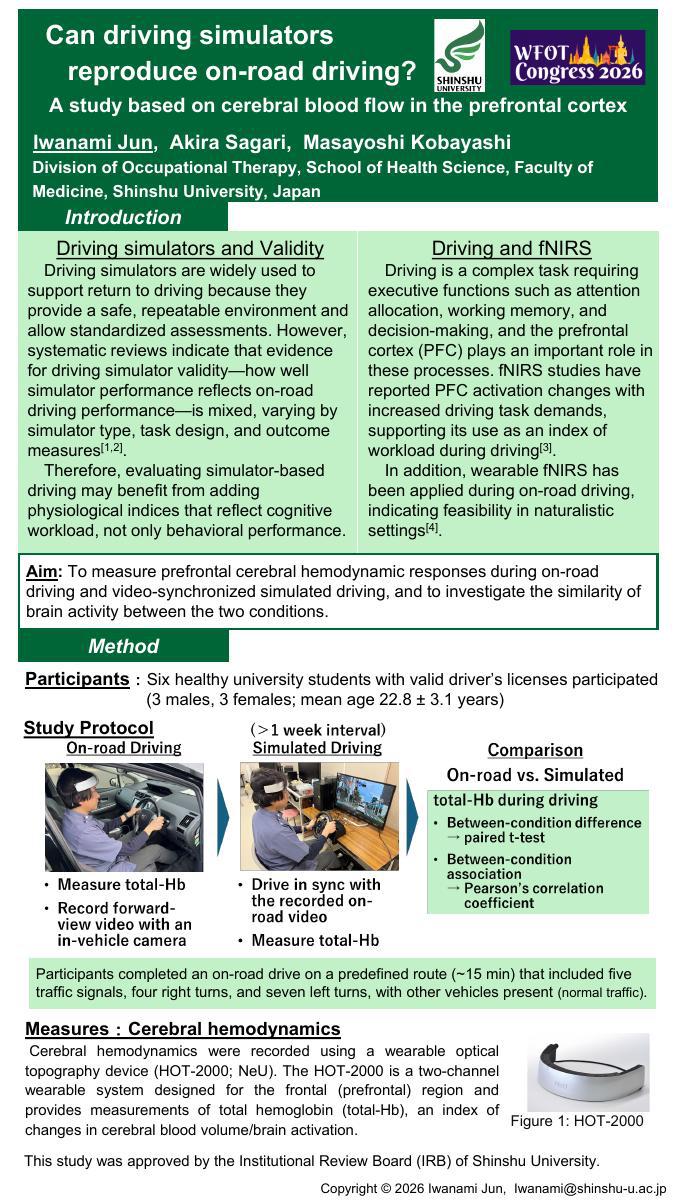
Introduction: Driving simulators have been utilized to assist people in resuming automobile driving after the onset of various illnesses. However, the relationship between driving simulators and actual driving has not been fully clarified.
Objectives: To measure cerebral blood flow during actual and simulated driving and to clarify the characteristics of cerebral activity.
Methods: Six healthy university students (mean age: 21.8 years) with a driver's license were subjects. The subjects drove a designated course (approximately 15 minutes) in a real car, and Oxygenated Hemoglobin (Oxy-Hb) in the prefrontal cortex was measured during the course. At the same time, a video camera attached to the front of the vehicle was used to capture video of the driving. The recorded driving video was then played back on a monitor, and the subject was asked to drive in sync with the video. Oxy-Hb in the prefrontal cortex was also measured during this simulated driving. Finally, Oxy-Hb was compared between real and simulated driving. This study was conducted with the approval of the ethics committee of the institution to which the subjects belonged.
Results: The mean Oxy-Hb values in the prefrontal cortex were not significantly different between real (0.26 ± 0.4 mM-mm) and simulated (0.51 ± 0.7 mM-mm) driving conditions. The correlation coefficient of prefrontal Oxy-Hb between real and simulated driving was 0.68, but not significant.
Conclusion: The results of this study suggest that the prefrontal cortex activity patterns in real car driving and driving simulators may be similar. This suggests that the use of driving simulators in driving rehabilitation may be effective.