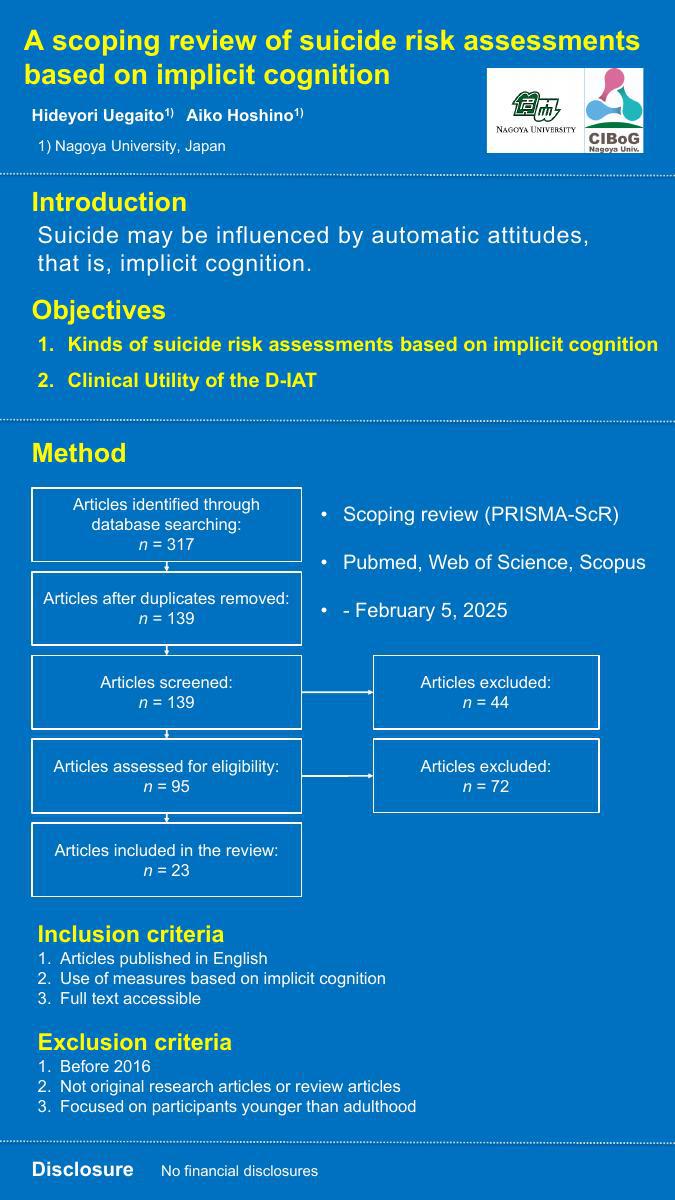
Introduction / Rationale: Suicide is a global public health issue. Within occupational therapy, the relationship between occupational engagement and suicide risk has been recognized, yet suicide risk assessment remains challenging. Occupational therapists typically rely on self-report measures, which are subject to biases such as stigma and reluctance to disclose suicidal thoughts. To address these limitations, suicide risk assessment methods based on implicit cognitions have been developed. These measures detect automatic associations between concepts related to death, self-injury, and self-concept, offering a more objective approach to risk assessment. Despite their potential to minimize bias, these methods have not been widely adopted in occupational therapy.
Objectives: This study aims to synthesize existing research on suicide risk assessments based on implicit cognitions and explore their implications for occupational therapy practice.
Methods / Approach: A scoping review was conducted using the PubMed, Web of Science, and Scopus databases, covering studies from 2016 to February 2025. The review adhered to PRISMA-ScR guidelines and included peer-reviewed articles that utilized implicit cognition measures for assessing suicide risk.
Results / Practice Implications: The search identified 75 studies, of which 37 met the inclusion criteria. Thirteen distinct evaluation methods were found, including two types of Stroop tasks (9 studies), eight variations of the Implicit Association Test (30 studies), and three other assessment methods (4 studies).
Conclusion / Contribution to the occupational therapy profession: Integrating implicit cognition-based suicide risk assessments into occupational therapy can enhance accuracy, minimize self-report biases, and improve the early detection of at-risk individuals. This approach strengthens suicide prevention efforts and supports occupational therapists in delivering more objective and targeted interventions.
