
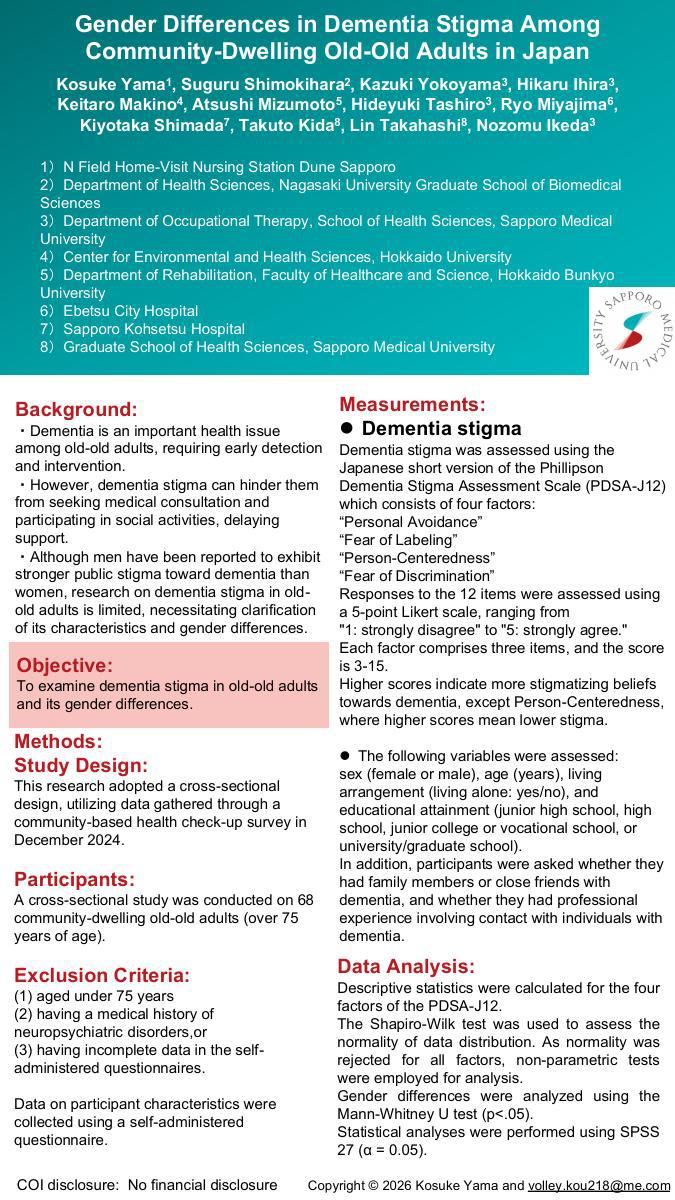
Introduction: Dementia is an important health issue among old-old adults, requiring early detection and intervention. However, dementia stigma can hinder them from seeking medical consultation and participating in social activities, delaying support. Although men have been reported to exhibit stronger public stigma toward dementia than women, research on dementia stigma in old-old adults is limited, necessitating clarification of its characteristics and gender differences.
Objectives: To examine dementia stigma in old-old adults and its gender differences.
Methods: A cross-sectional study was conducted on 68 community-dwelling old-old adults (over 75 years of age). Dementia stigma was assessed using the Japanese version of the Phillipson Dementia Stigma Assessment Scale (PDSA-J12), which consists of four factors: “Personal Avoidance,” “Fear of Labeling,” “Person-Centeredness,” and “Fear of Discrimination.” Each factor comprises three items, and the score is 3-15. Higher scores indicate more stigmatizing beliefs towards dementia, except Person-Centeredness, where higher scores mean lower stigma. Gender differences were analyzed using the Mann-Whitney U test (p<.05).
Results: PDSA-J12 factor scores (median [IQR]) were Personal Avoidance 7 [6-9], Fear of Labeling 10 [9-12], Person-Centeredness 9 [7-9], and Fear of Discrimination 7 [6-9]. Normality was rejected for all four factors (Shapiro-Wilk test, p<.05). No significant gender differences were found in any factor (p = 0.350–0.845) or the 12 items (p>.05).
Conclusion: Dementia stigma varies individually, with no significant gender differences. Factors such as having a close acquaintance with dementia or prior contact experience may influence dementia stigma more than gender. Further research should explore dementia stigma in detail.