
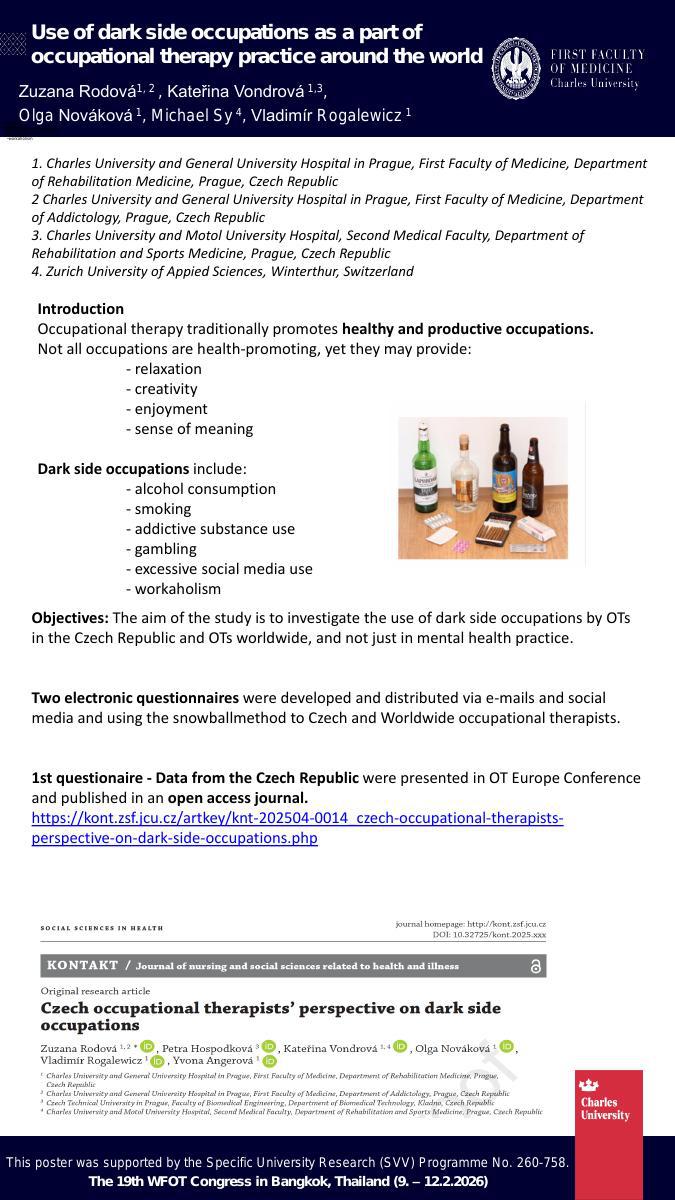
Introduction: Occupational therapists (OTs) mainly focus on productive and positive occupations leading to good health. Not all activities are healthy and productive, but they can provide a client with a sense of well-being when their meaning and significance (relaxation, creativity, celebrations, entertainment) are important. Dark side occupations include eg. drinking alcohol, smoking, using addictive substances, gambling, excessive use of social networks or workaholism.
Objectives: The aim of the study is to investigate the use of dark side occupations by OTs worldwide, and not just in mental health practice.
Methods: A web-based questionnaire with 18 questions was prepared. After evaluating pilot feedback from 4 OTs from 4 continents, it was finalized and distributed via emails and social media. So far, 365 fully completed questionnaires from 60 countries around the world have been collected anonymously using the snowball method, and analysed by descriptive statistics.
Results: The research is still ongoing and accepting further responses. First results show big diversity: on the one hand, 43% therapists are open to all topics, while 57% have topics they don't want to open, like sex (44.1%) or using addictive substances (22.7%). Dark side occupations are never used as a target of therapy by 30.7% OTs, 55.6% sometimes, 9% often, and 4.7% always. The term dark side occupation itself is very controversial, a whole range of opinions shows up.
Conclusion: OTs need to understand dark side occupations and admit that their clients perform them. The challenge is to encourage participation in more pro-social, healthy and productive occupations.